

A flexible polyhedron is a polyhedron that can change shape continuously while its faces remain congruent. The rigidity theorem states that if the faces of a convex polyhedron are made of metal plates and the polyhedron edges are replaced by hinges, then the polyhedron is rigid. Concave polyhedra need not be rigid. Infinitesimal motion must be distinguished from a continuous flex. A shaky polyhedron is infinitesimally movable but can still be rigid against continuous flexing (Cromwell 1997, p. 241).
Mason's polyhedron has 32 triangular faces, 18 vertices, and 48 edges. It is constructed by erecting a pyramid on each face of a cube and separating one of the pyramids from the cube by a square antiprism (Cromwell 1997, p. 222). It is shaky but rigid, so it is not an example of a continuously flexible polyhedron (Cromwell 1997, pp. 241-242).
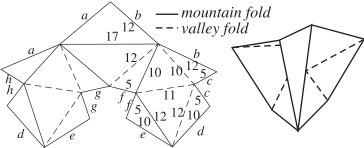
In 1897, Bricard constructed several self-intersecting flexible octahedra (Cromwell 1997, p. 239). Connelly (1978) found the first example of a true flexible polyhedron, consisting of 18 triangular faces (Cromwell 1997, pp. 242-244). Kuiper and Deligne modified Connelly's polyhedron to create a flexible polyhedron having 18 faces and 11 vertices (Cromwell 1997, p. 245), and Steffen found a flexible polyhedron with only 14 triangular faces and 9 vertices (shown above; Cromwell 1997, pp. 244-247; Mackenzie 1998).
Maksimov (1995) proved that no flexible embedded polyhedron has seven vertices and reduced the unresolved 8-vertex case to a single possible combinatorial structure. Thus later descriptions of this result as a proof that Steffen's 9-vertex polyhedron was minimal were too strong (Cromwell 1997, p. 245). Gallet et al. (2024) resolved the remaining case with a flexible realization having the combinatorial structure of a pentagonal dipyramid. Subdividing one face into three produced a flexible embedded polyhedron with 12 triangular faces and 8 vertices. The minimum number of vertices in a flexible embedded polyhedron is therefore 8.
Connelly et al. (1997) proved that a flexible polyhedron must keep its volume constant, confirming the so-called bellows conjecture (Mackenzie 1998).
