


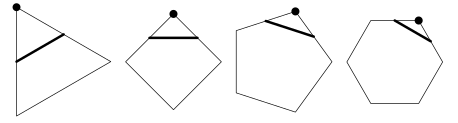
The vertex figure at a polygon vertex  of a polygon is the line
segment joining the midpoints of the two adjacent
sides meeting at
 . For a regular
 -gon with edge length
 , the length
 of the vertex figure is
 |

The vertex figure at a polyhedron vertex  of a polyhedron
is the polygon whose sides
are the vertex figures of the faces surrounding
 . The faces that join at a polyhedron
vertex form a solid angle whose section by the
plane is the vertex figure, as illustrated above for one
polyhedron vertex of the cube.
For a  -dimensional
convex polytope with
 , a vertex figure is a
 -dimensional polytope formed
by intersecting the convex polytope with a hyperplane that separates one polytope
vertex from all the others. The convex polytope
is a simple polytope iff
every vertex figure is a
 -simplex (Renner 2009). In three dimensions, a convex
polyhedron is therefore a simple polyhedron
in the combinatorial sense iff all its vertex figures are
triangles, which are 2-simplices.
This simplex condition on vertex figures is distinct from the condition defining a simplicial polytope, whose facets are simplices. Every simplex satisfies both conditions (Fukuda 2004).

The vertex figures of the Platonic solids yield the polyhedra (with holes centered on the centroids of the original faces) whose convex hulls are illustrated above and summarized in the following table.
| polyhedron | convex hull of vertex figures |
| cube | cuboctahedron |
| dodecahedron | icosidodecahedron |
| icosahedron | icosidodecahedron |
| octahedron | cuboctahedron |
| tetrahedron | octahedron |


The illustrations above show the Archimedean solids, their vertex figures, and the solids obtained by taking the convex hulls of the vertex figures.
