


An inellipse is an inconic that is an ellipse.
The locus of the centers of the ellipses inscribed in a triangle is the interior of the medial triangle. Newton gave the solution to inscribing an ellipse in a convex quadrilateral (Dörrie 1965, p. 217).
The area of an inellipse with center having areal coordinates  inscribed in a triangle is
 |
(1)
|
where  is the area
of the reference triangle (Chakerian 1979,
pp. 143 and 148), which corresponds to an inellipse with center having exact
trilinear coordinates
is the area
of the reference triangle (Chakerian 1979,
pp. 143 and 148), which corresponds to an inellipse with center having exact
trilinear coordinates  having area
 |  |  |
(2)
|
 |  |  |
(3)
|
In terms of the inconic parameters  , the formula is even simpler,
 |
(4)
|
(E. W. Weisstein, Dec. 4, 2005).
The following table summarizes the areas of some special inellipses.
| inellipse | center | area |
| Brocard inellipse |  | 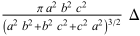 |
Hofstadter ellipse
with  |  | 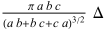 |
| incircle |  |  |
| Lemoine inellipse |  |  |
| Macbeath inconic |  | 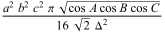 |
| Mandart inellipse |  | ![(16piDelta^3)/((a+b+c)[2ab+2bc+2ca-(a^2+b^2+c^2)]^(3/2))](/images/equations/Inellipse/Inline23.svg) |
| orthic inconic |  |  |
| Steiner inellipse |  |  |
For a convex quadrilateral that is not a parallelogram, the centers of its inellipses are precisely the points of the open line segment joining the midpoints of the polygon diagonals. Each point of this segment is the center of a unique inellipse. For a parallelogram, every inellipse is centered at the common midpoint of the diagonals (Chakerian 1979, pp. 136-139; Horwitz 2005).
Every convex quadrilateral has a unique inellipse of maximal area, namely its John
ellipsoid in two dimensions. If  is any ellipse inscribed in a convex quadrilateral
  , then
 |
(5)
|
with equality iff  is a parallelogram and
  is tangent to its sides at their midpoints
(Horwitz 2010).
is tangent to its sides at their midpoints
(Horwitz 2010).
