


The six-piece geometry of triangle dissections concerns the interior junctions and boundary cut points of a generic non-right triangle divided into six pieces similar to itself. Two layouts are identified when an isometry of the original triangle maps their collections of pieces to each other. Tiles may be directly similar or inversely similar and may have different scale factors. A triangle is generic here when no additional relation among its angles or sides makes otherwise distinct arrangements coincide or produces exceptional arrangements.

A catalog prepared by E. Pegg, Jr. (pers. comm., Oct. 3, 2026) lists 36 six-piece dissections of a generic non-right triangle into triangles similar to itself. They fall into twelve groups of three cyclically related layouts. Each layout has one interior junction and four additional boundary cut points. The interior junctions have the following classification.
| interior junction | groups | layouts |
| vertices of first Brocard triangle | 5, 6, 12 | 9 |
| vertices of third Brocard triangle | 10 | 3 |
vertices
of  | 2, 3 | 6 |
vertices of  | 1, 4 | 6 |
vertices of  | 7 | 3 |
vertices of  | 8 | 3 |
| triangle centroid | 9 | 3 |
| symmedian point | 11 | 3 |
Here  and
 denote two median-symmedian triangles,
and
 and
 denote two median-Brocard triangles.
These labels are local to this classification. Let
 ,
 , and
 be the medians and
 ,
 ,
and
 the symmedians of
 . Writing
 and
 for the first
and second Brocard points, respectively, the
four triangles have vertices
 |  |  |
(1)
|
 |  |  |
(2)
|
 |  |  |
(3)
|
 |  |  |
(4)
|
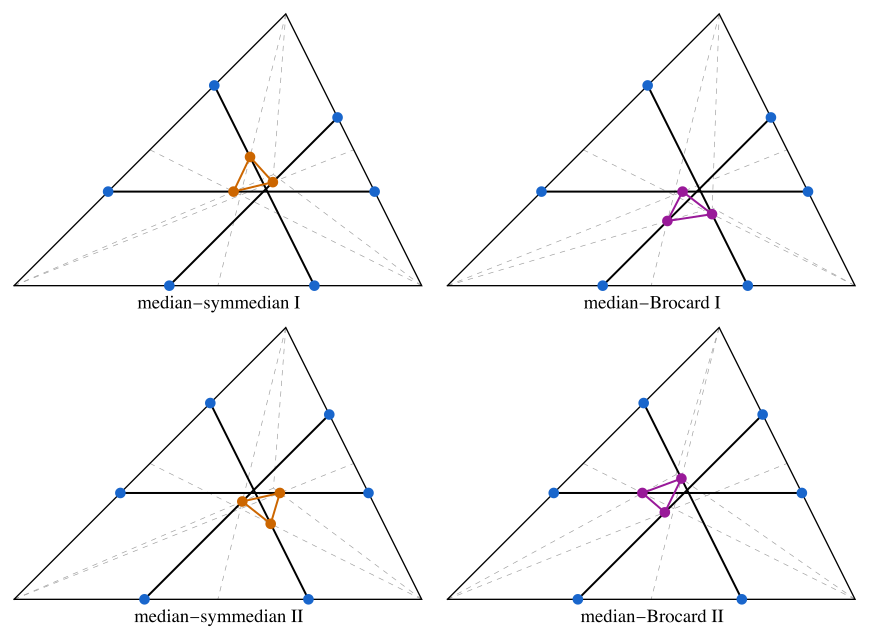
Groups 3 and 7 have the same three straight-through cuts, despite using the different interior triangles  and
 . Groups 4 and 8 similarly share their cuts while using
 and
 . The paired constructions are illustrated above. The
same median-symmedian triangle also admits a different
system of cuts in groups 2 and 1, respectively (E. Pegg, Jr., pers. comm., Oct. 3,
2026).
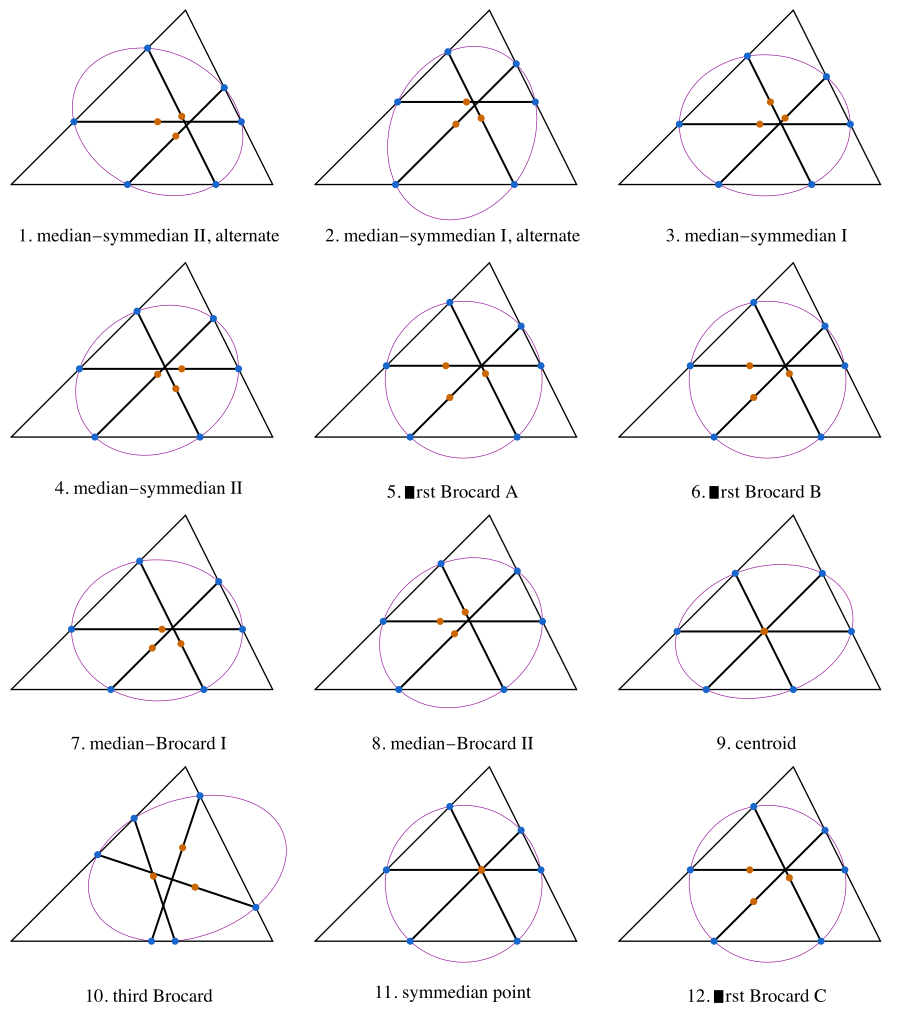
In each layout, one cut continues straight through the interior junction from one boundary cut point to another. For a group of three layouts, these cuts have six endpoints, two on each side. Their cyclic product of six signed ratios is 1, so Carnot's conic theorem places them on a common conic section. The twelve groups therefore give twelve six-point sets, with repeated conics when cuts are shared. Groups 5, 6, 11, and 12 all use the three lines through the symmedian point parallel to the sides. Their six endpoints lie on the same first Lemoine circle (E. Pegg, Jr., pers. comm., Oct. 3, 2026).
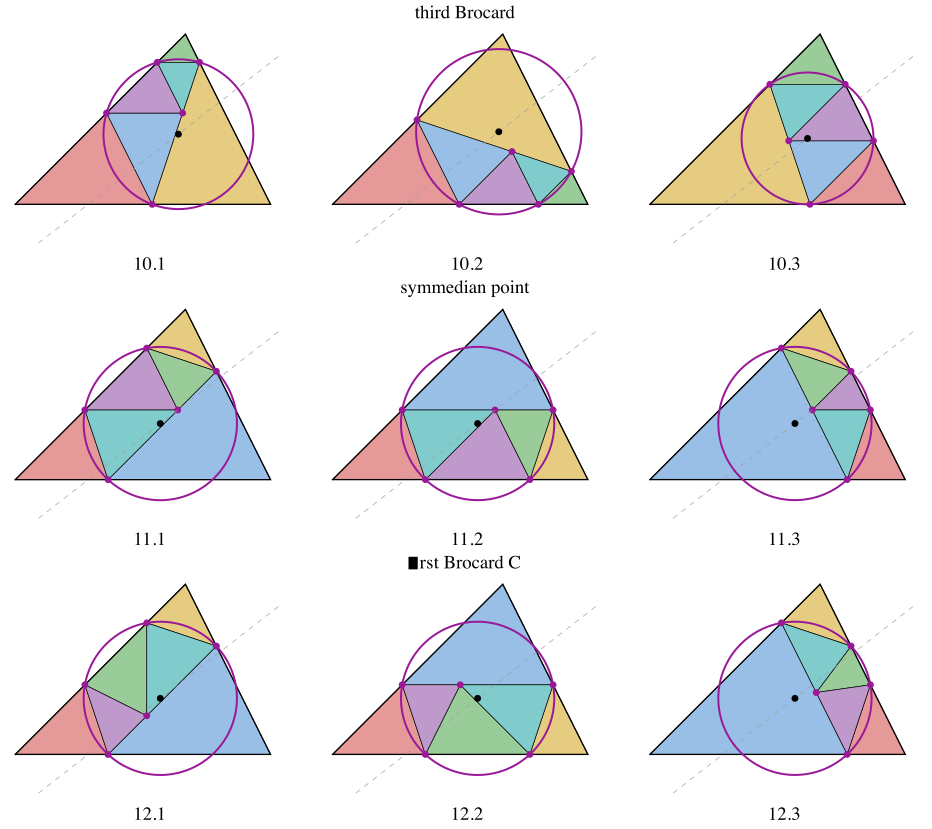
Testing the four boundary cut points of an individual layout instead gives exactly nine concyclic cases. The three layouts in group 10 give three distinct circles, with interior junctions at the vertices of the third Brocard triangle. The six layouts in groups 11 and 12 all use the first Lemoine circle. Thus there are four distinct circles, and all four centers lie on the Brocard axis (E. Pegg, Jr., pers. comm., Oct. 3, 2026).

 Pegg, E. Jr. "Six-Part Similar Triangle
Dissections." Wolfram Demonstrations Project. 2026.