


Carnot's conic theorem is a criterion for six points, two on each extended side of a triangle,
to lie on a common conic section. Let  ,
 lie on
 ,
 ,
 on
 , and
 ,
 on
 , with the six points distinct and
none a vertex of
 . They lie on a common, possibly degenerate,
conic section iff
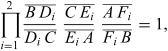 |
where  is the signed length from
 to
 in a fixed orientation of the relevant line.
Changing that orientation changes both signs in each ratio,
so the ratios are independent of the choices of orientation
(Szilasi 2012).
A proof uses barycentric coordinates  relative to
 . Write the conic section
as
 .
Since the conic section avoids the vertices,
 ,
 ,
and
 are nonzero. On
 ,
the two values of
 have product
 by Vieta's formulas. On
 and
 , the corresponding products of
 and
 are
 and
 . Their product is 1. Conversely, these three products determine
compatible nonzero
 ,
 , and
 exactly when their product is 1. The sums of each pair of
polynomial roots then determine
 ,
 , and
 , giving a conic section through
all six points.
The theorem generalizes Menelaus' theorem. For  finite intersections, counted with multiplicity,
on each extended side with an algebraic
curve of polynomial degree
 that avoids the vertices and has
no side as a component, the corresponding relation is
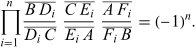 |
Menelaus' theorem and Carnot's conic theorem are the cases  and
 ,
respectively (Szilasi 2012).
