


A triangle dissection divides a triangle into finitely many smaller triangles with nonoverlapping interiors.
Hoggatt and Denman (1961) showed that any obtuse triangle can be divided into eight acute isosceles triangles.
There are 1, 4, 23, 180, 1806, 20198, ... (OEIS A056814) topologically distinct ways to divide a triangle into
 ,
3, ... smaller triangles (Vicher).
,
3, ... smaller triangles (Vicher).
A triangle partition is prime if it does not contain a triangle partition of lower order. The numbers of prime triangle partitions of orders  , 3, ... are 1, 1, 3, 8, 62, 535, 4213, ... (OEIS A053740).
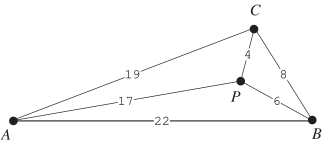
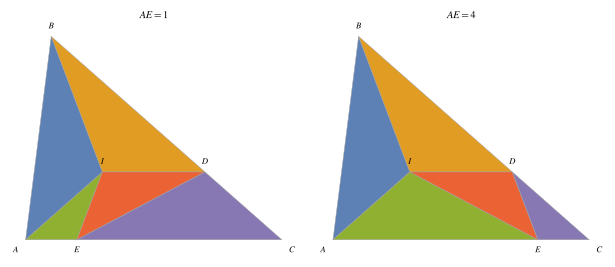
A specific type of triangle dissection consists of a triangle  together with an interior point
  such that the original side lengths
and the additional three line segments created by
connecting the triangulation point
with the vertices are all integers.
An example of such a dissection is illustrated above (Pegg).
such that the original side lengths
and the additional three line segments created by
connecting the triangulation point
with the vertices are all integers.
An example of such a dissection is illustrated above (Pegg).
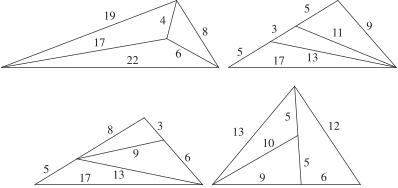
Other possible dissections allow cut lines to be drawn from arbitrary points along the sides. Allowing only primitive triangles without any parallel lines, isosceles triangles, or similar triangles, the smallest three-piece integer dissection of each of the four possible types is illustrated above.
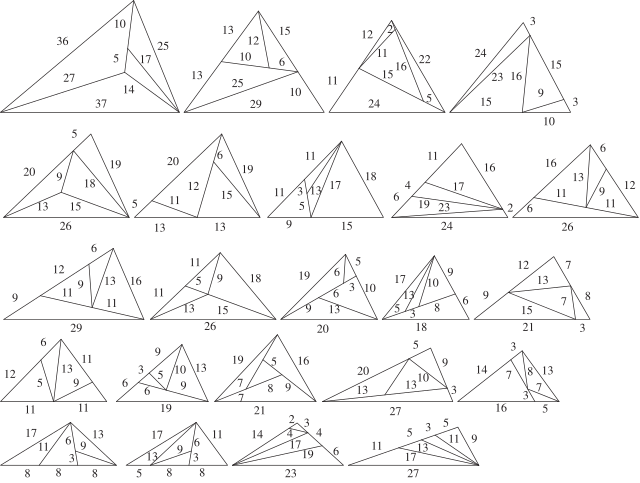
Similarly, the smallest four-piece integer dissection for each of the 23 possible types is shown above.
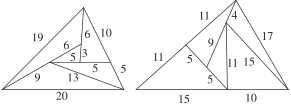
Two 5-piece dissections are illustrated above (Pegg).
For a fixed triangle  , let
, let  denote the number of dissections of
  into
into  triangles, each similar
to
triangles, each similar
to  .
Two dissections are identified when they determine the same collection of triangular
regions, so the order of the tiles and the order of their
vertices are ignored. Tiles may be directly
similar or inversely similar, and their
scale factors need not be equal. This differs from
a rep-tile dissection, in which the smaller copies are
required to be congruent.
.
Two dissections are identified when they determine the same collection of triangular
regions, so the order of the tiles and the order of their
vertices are ignored. Tiles may be directly
similar or inversely similar, and their
scale factors need not be equal. This differs from
a rep-tile dissection, in which the smaller copies are
required to be congruent.
A triangle is called generic here when no additional relation among its angles or sides makes otherwise distinct arrangements coincide or produces exceptional arrangements. The computed counts for several generic and special classes are summarized below (E. Pegg, Jr., pers. comm., Sep. 28, 2026).
| class | OEIS | counts beginning at  |
| generic non-right triangle | A399765 | 1, 0, 0, 4, 0, 36, 64, 468, 1792, 9262 |
| generic isosceles triangle | A400510 | 1, 0, 0, 2, 0, 11, 19, 108, 385, 1747 |
| generic right triangle | A399770 | 1, 1, 2, 10, 60, 363, 2346, 16581 |
| Kepler triangle | 1, 1, 2, 10, 60, 363, 2345 | |
| isosceles right triangle | A400511 | 1, 1, 1, 5, 20, 100, 543, 3209, 19986 |
| 30-60-90 triangle | A400462 | 1, 1, 3, 18, 121, 844, 6397, 53145 |
The first value counts the uncut triangle. A 3-4-5 right triangle realizes the generic right-triangle counts. A computational enumeration based on dissection topologies by B. Trease, together with an independent coordinate search, verified the displayed generic right values (Pegg 2026). The 4-5-6 triangle, 45-60-75 triangle, and heptagonal triangle have the generic non-right counts through ten pieces (E. Pegg, Jr., pers. comm., Sep. 28, 2026).
Among the 36 catalogued six-piece dissections of a generic non-right triangle into triangles similar to itself, 12 have their interior vertex at either the symmedian point (3 arrangements) or a vertex of the first Brocard triangle (9 arrangements) (E. Pegg, Jr., pers. comm., Oct. 1, 2026).
Three further six-piece arrangements have their interior vertices at the vertices of the third Brocard triangle. In each arrangement, the four points where cuts meet the sides lie on a circle. The centers of these three circles lie on the Brocard axis (E. Pegg, Jr., pers. comm., Oct. 1, 2026).
Special relations among sides can nevertheless change a count. For the Kepler triangle, two layouts that are distinct for a generic right triangle coalesce into a single configuration at the Kepler proportions, giving a seven-piece count of 2345 rather than 2346 (E. Pegg, Jr., pers. comm., Sep. 28, 2026).
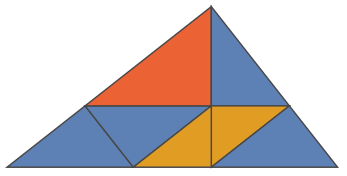
The exceptional seven-piece dissection of the Kepler triangle is illustrated above. Five pieces meet at the interior point.
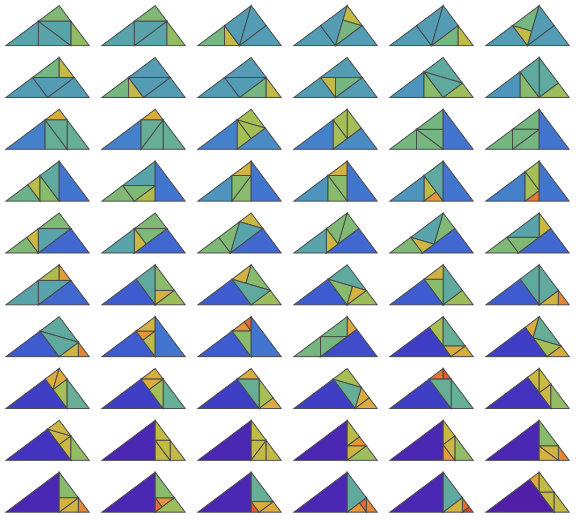
The 60 five-piece dissections are illustrated above with coloring by B. Trease (Pegg 2026). The altitude from the vertex
of the right angle to the hypotenuse
gives the unique two-piece dissection, and subdividing either resulting triangle
in the same way produces the two three-piece layouts in the enumeration. More generally,
Zak (2005) proved that every triangle can be dissected
into  triangles similar to it for
 or
or  .
.
If the pieces need only be mutually similar, their shape can differ from that of the original triangle. Zak (2005) proved that exactly nine shapes of triangle, up to similarity, admit a dissection into five mutually similar non-right triangles. Among non-right triangles, only the isosceles triangle with angles 30, 30, and 120 degrees admits five pieces similar to the original.
A 4-5-6 triangle admits two five-piece dissections into mutually similar triangles
with side lengths in the ratio  (Pegg 2019). These pieces are not similar
to the original, so the constructions do not contribute to
(Pegg 2019). These pieces are not similar
to the original, so the constructions do not contribute to  .
.
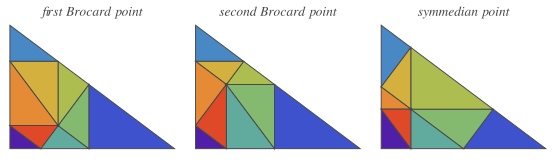
The three exact nine-piece constructions illustrated above have a single interior vertex at the first
Brocard point, second Brocard point, or
symmedian point. For the outer vertices  ,
,  , and
, and  , the corresponding barycentric
coordinates are
, the corresponding barycentric
coordinates are  ,
,  , and
, and  . Exact area and intersection
calculations verify that each construction covers the 3-4-5 right
triangle by nine nonoverlapping triangles similar
to it (Pegg 2026).
. Exact area and intersection
calculations verify that each construction covers the 3-4-5 right
triangle by nine nonoverlapping triangles similar
to it (Pegg 2026).
For a 30-60-90 triangle, Pegg et al. (to appear) found that the numbers of arrangements with  , 2, ... pieces are 1, 1, 3, 18, 121, 844, 6397, 53145, ...
(OEIS A400462). The 18 four-piece arrangements
use 11 distinct multisets of piece areas.
The 121 five-piece arrangements use 47 distinct such multisets,
while the 844 six-piece arrangements use 235.
, 2, ... pieces are 1, 1, 3, 18, 121, 844, 6397, 53145, ...
(OEIS A400462). The 18 four-piece arrangements
use 11 distinct multisets of piece areas.
The 121 five-piece arrangements use 47 distinct such multisets,
while the 844 six-piece arrangements use 235.
An arrangement is independent if it cannot be obtained from another catalogued arrangement by subdivision or by a local rotation or reflection. Among the five-piece arrangements, 84 arise by subdivision and 31 more have such a local partner, leaving 6 independent arrangements. The corresponding six-piece counts are 667, 154, and 23. There are 104 independent seven-piece arrangements. The 53145 eight-piece arrangements use 8793 distinct multisets of piece areas and include 731 independent arrangements. Altogether, the catalog through eight pieces contains 60530 arrangements (E. Pegg, Jr., pers. comm., Sep. 27, 2026). A complete search cannot be restricted to edge-to-edge triangulations: some valid layouts contain T-junctions, while others have an interior fan at which several right angle vertices meet without any triangle side continuing through the junction (Pegg et al. , to appear).
Laczkovich (1995) proved that every dissection of an equilateral triangle into similar
triangles has a tile angle equal to 60 or 120 degrees.
There exists an infinite family realizing the 120-degree case (Pegg 2026). Let  be a positive
integer, and let
be a positive
integer, and let  be the unique positive real root of
 |
(1)
|
The polynomial has value  at
at  and tends to
  as
as  , so such a root exists.
Uniqueness follows from Descartes' rule of signs.
The law of cosines shows that a triangle
with sides proportional to
, so such a root exists.
Uniqueness follows from Descartes' rule of signs.
The law of cosines shows that a triangle
with sides proportional to  ,
,  , and
, and  has an included angle of
120 degrees. Copies of this triangle with scale
factors
has an included angle of
120 degrees. Copies of this triangle with scale
factors  ,
,
 ,
...,
,
...,  ,
with the scale factors
,
with the scale factors  and
and  each occurring twice, form a dissection of an equilateral
triangle into
each occurring twice, form a dissection of an equilateral
triangle into  similar triangles. Two outer sides
have length proportional to
similar triangles. Two outer sides
have length proportional to  , while the third has length proportional to
  . Their equality
follows from
. Their equality
follows from
 |
(2)
|
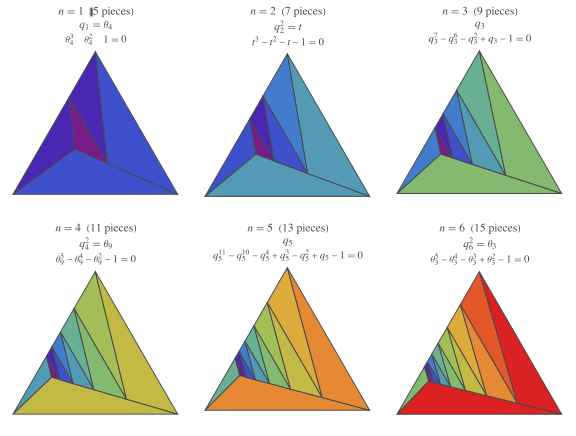
The six cases  ,
..., 6 are shown above in reading order. For even
,
..., 6 are shown above in reading order. For even  , put
, put  . Then
  is the unique positive real
root of
is the unique positive real
root of
 |
(3)
|
The first three roots are the tribonacci constant,  ,
and
,
and  ,
respectively, since
,
respectively, since
 |  |  |
(4)
|
 |  |  |
(5)
|
 |  |  |
(6)
|
The roots  are strictly decreasing. Since
  ,
,
![P_(k+1)(x_k)-P_k(x_k)=(x_k-1)x_k^k[x_k^k(x_k^2-1)-1]>0.](/images/equations/TriangleDissection/NumberedEquation4.svg) |
(7)
|
Since  and
and  has only one positive real
root by Descartes' rule of signs, it follows
that
has only one positive real
root by Descartes' rule of signs, it follows
that  .
Now
.
Now  lies strictly between the two smallest Pisot numbers
  and
and  , while
  . It follows that
  is a Pisot number precisely
for
is a Pisot number precisely
for  ,
2, or 3. Also,
,
2, or 3. Also,  follows from
  .
The construction uses only the positive real
root of the displayed polynomial, so the Pisot
property is not required.
.
The construction uses only the positive real
root of the displayed polynomial, so the Pisot
property is not required.

 Pegg, E. Jr. Mathematical Games. Episode 45: "Filling Space with
Similar Parts." Sep. 24, 2026.
Pegg, E. Jr. Mathematical Games. Episode 45: "Filling Space with
Similar Parts." Sep. 24, 2026. 