


Exceptional shapes for triangle dissections into pieces similar to the original triangle have arrangements that coalesce or additional arrangements beyond those of a generic triangle of the same class. A triangle is generic here when no additional relation among its angles or sides makes otherwise distinct arrangements coincide or produces exceptional arrangements. Counts identify layouts under isometries of the original triangle, allowing directly similar and inversely similar pieces with different scale factors.
Special relations among sides can change a count. For the Kepler triangle, two layouts that are distinct for a generic right triangle coalesce into a single configuration at the Kepler proportions, giving a seven-piece count of 2345 rather than 2346 (E. Pegg, Jr., pers. comm., Sep. 28, 2026).
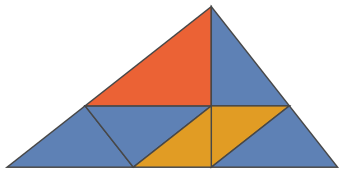
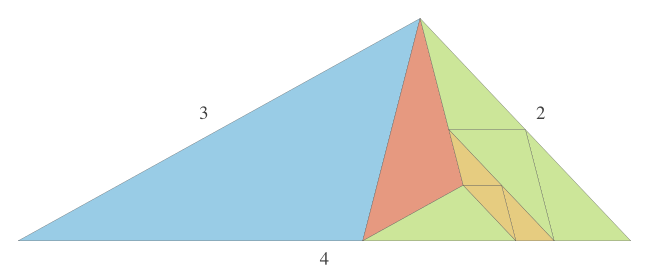
The exceptional seven-piece dissection of the Kepler triangle is illustrated above. Five pieces meet at the interior point.
Pegg calls the following coalescence examples "convergent triangles" (E. Pegg, Jr., pers. comm., Oct. 8, 2026). Write  for the short leg divided by the long
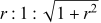
leg, so the side lengths are in
the ratio
 . Each equation in the table selects its unique
real root in
 . Here
 is the number of pieces and
 is the number of pieces meeting at the coalesced interior
point. The catalog gives exact constructions, without asserting
minimality of
 or completeness of the listed shapes.
equation for  |  |  |
 | 7 | 5 |
 | 8 | 4 |
 | 8 | 5 |
 | 9 | 5 |
 | 9 | 5 |
 | 9 | 4 |
 | 9 | 5 |
 | 9 | 4 |
 | 9 | 5 |
 | 9 | 5 |
 | 9 | 5 |
The seven-piece case is the Kepler triangle, with side lengths  , where
 is the golden ratio.
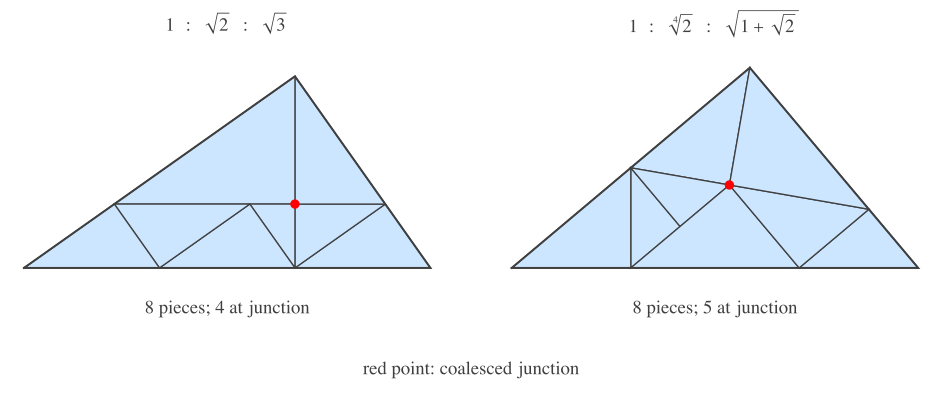
The two eight-piece cases illustrated above have side lengths  and
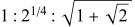 , respectively. The red interior points mark junctions at which four and five pieces meet,
respectively.
Requiring points whose coordinates are rational functions of a shape parameter to coincide gives polynomial equations after denominators are cleared. The listed equations have integer coefficients, so their roots are algebraic numbers. A nonzero polynomial has only finitely many roots, explaining why each such condition selects isolated proportions.
Pegg uses the term "sporadic similar triangle" for a triangle that admits additional arrangements beyond those of a generic triangle of the same class (E. Pegg, Jr., pers. comm., Oct. 7, 2026). This terminology refers to a gain in arrangements relative to the generic count. For example, an extra three-piece arrangement occurs for a 30-60-90 triangle, whereas a generic right triangle has two three-piece arrangements. Coalescence of arrangements, as for the Kepler triangle, can instead reduce a count.
Pegg's October 2026 collection contains 1569 stored dissections of 106 special triangle shapes (E. Pegg, Jr., pers. comm., Oct. 22, 2026).
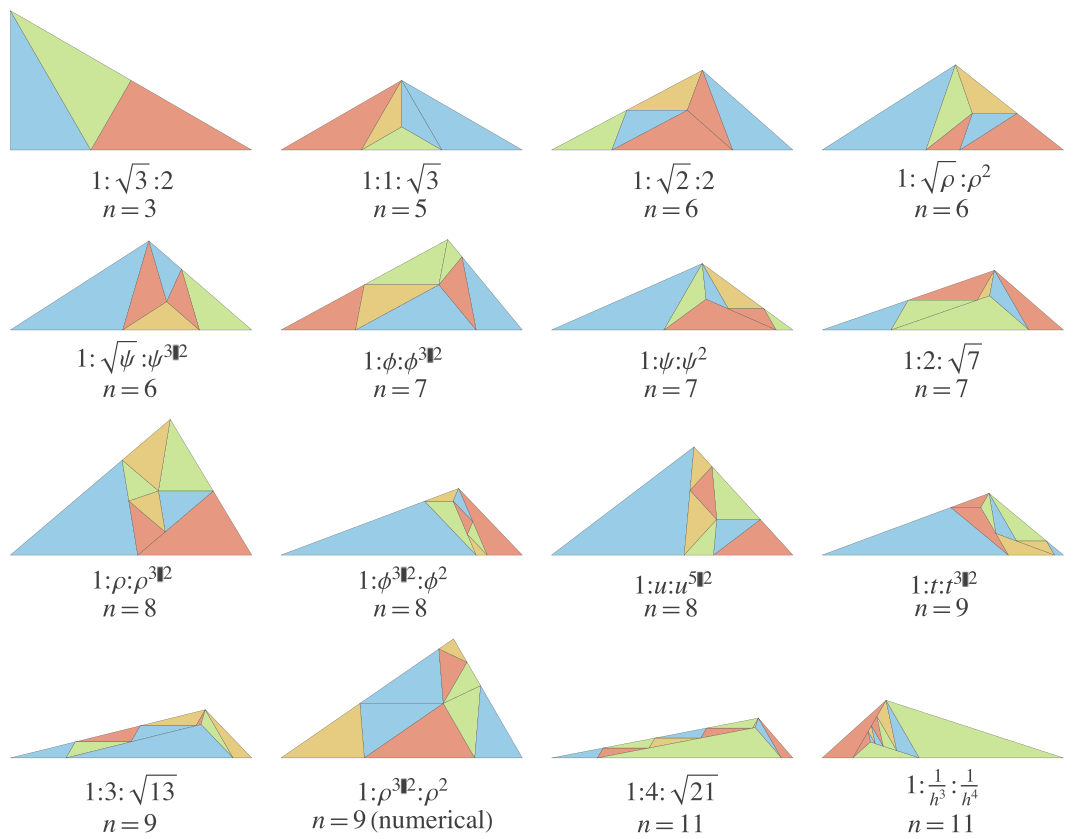
The following catalog lists representative dissections supplied by E. Pegg, Jr. (pers. comm., Oct. 7, 2026). Here  is the number of pieces in the specified construction, and
does not by itself assert minimality or a complete enumeration of exceptional shapes.
Write
 for the golden ratio,
 for the supergolden ratio,
 for the plastic constant,
and
 for the tribonacci constant.
The remaining parameters are the unique positive real roots
 of
 and
 of
 .
| side ratios |  |
 | 3 |
 | 5 |
 | 6 |
 | 6 |
 | 6 |
 | 7 |
 | 7 |
 | 7 |
 | 8 |
 | 8 |
 | 8 |
 | 9 |
 | 9 |
 | 9 |
 | 11 |
 | 11 |
The  nine-piece example is a numerical witness.
The other rows have exact constructions, but minimality of the first exceptional
count has not been established for the two eleven-piece examples. The parameter
 is distinct from the superplastic ratio
 ,
which satisfies
 .
For the examples with side lengths that are powers of a common base, Pegg's label  -abc means side lengths
 , so the digits are exponents
of squared side lengths. For example,
 -012 means
 and
 -014 means
 . Several bases are self-summing
ratios.
An additional example has side lengths  and admits a nine-piece dissection
into similar triangles (E. Pegg, Jr., pers.
comm.). Its piece areas, relative to the original triangle,
are
 ,
 , four copies of
 , and three copies of
 . These sum to 1. The construction does not establish a
first exceptional count for this shape.
Pegg also reports a cube root family with side lengths  , where
 and
 is an integer, with
 pieces (E. Pegg, Jr., pers. comm.). The communicated examples have
 , 3, and 4, with 7, 9, and 11 pieces, respectively. The law of cosines gives an included angle
of 120 degrees between the sides of lengths 1 and
 . A general exact construction remains to be supplied. This
family differs from the exact integer family with side lengths
 and
 pieces for positive integers
 .
Neither formula asserts minimality. For example,
 in the cube root family gives
 with 19 pieces, while the catalog contains a seven-piece construction of the same
shape.

 Pegg, E. Jr. Mathematical Games. Episode
46: "Sporadic Similar Triangles." Oct. 22, 2026.