


The term "HSBC graph" is used in this work for the seven-vertex, twelve-edge planar graph formed by the boundaries of the six triangular regions in HSBC's hexagonal logo, shown above (Deza and Shtogrin 2002, HSBC, HSBC History).
The same graph is common to seven six-piece triangle dissections supplied by E. Pegg, Jr. (pers. comm., Nov. 6, 2026). The vertices are the corners and junctions of the pieces, and the edges join consecutive vertices along the sides of the pieces.
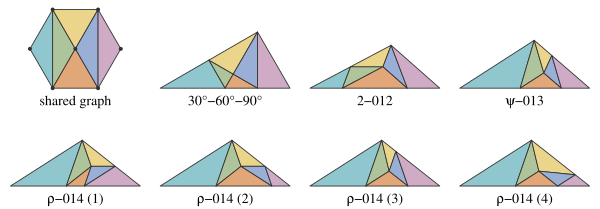
The graph is illustrated above in several straight-line embeddings. In each of the seven dissections, the pieces
are similar triangles with the same shape as
the outer triangle. The seven layouts use four outer
shapes, including four different arrangements in the same  -014 triangle, where
 is the plastic constant.
Corresponding bounded faces have the same color.
It is also the line graph  of the fourth Beineke graph.
The Chase graph is another planar
graph defined by the boundaries of a bank logo.
The graph will be implemented in a future version of the Wolfram Language as GraphData["HSBCGraph"].

