


The term "reciprocal proportion triangle" is used in this work to describe a triangle whose side lengths
are in the proportion  . In order for such a triangle
to exist, the triangle inequality requires
. In order for such a triangle
to exist, the triangle inequality requires
 |
(1)
|
When combined with the requirement that side lengths be positive, the values of  for which a reciprocal proportion triangle exists are
  ,
i.e.,
,
i.e.,  ,
where
,
where  is the golden ratio.
This means that reciprocal proportion triangles do not exist for common constants like  ,
,  , the golden ratio
  , and the Khinchin constant
  .
However, they do exist for the Glaisher-Kinkelin
constant
.
However, they do exist for the Glaisher-Kinkelin
constant  , plastic constant
  ,
supergolden ratio
,
supergolden ratio  , and square root of the golden
ratio
, and square root of the golden
ratio  .
.
The following table summarizes some reciprocal proportion triangles.
 | triangle |
supergolden ratio  | supergolden triangle |
square root of golden
ratio  | Kepler triangle |
plastic
constant  | plastic triangle |
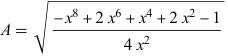
When a reciprocal proportion triangle exists with ratio  ,
it has area
,
it has area
 |
(2)
|
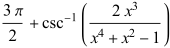
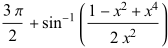
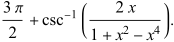
and angles
 |  |  |
(3)
|
 |  |  |
(4)
|
 |  |  |
(5)
|
Pegg (2016) terms triangles whose side lengths are powers of a common base "power triangles."
For example, the power triangle with base  and exponents 0, 1, and 2 has side
lengths
and exponents 0, 1, and 2 has side
lengths  ,
,  , and
, and  . A number of power triangles have exceptional
additional dissections into similar
triangles (E. Pegg, Jr., pers. comm., Sep. 28, 2026). Iterating such
a dissection gives a multiscale substitution
tiling rule because the child triangles can have
different scale factors.
. A number of power triangles have exceptional
additional dissections into similar
triangles (E. Pegg, Jr., pers. comm., Sep. 28, 2026). Iterating such
a dissection gives a multiscale substitution
tiling rule because the child triangles can have
different scale factors.

 Pegg, E. Jr. "Wheels of Powered Triangles."
2016.
Pegg, E. Jr. "Wheels of Powered Triangles."
2016.  ,
,
 ,
,
 ,
,
 ."
Mar. 7, 2019.
."
Mar. 7, 2019.