


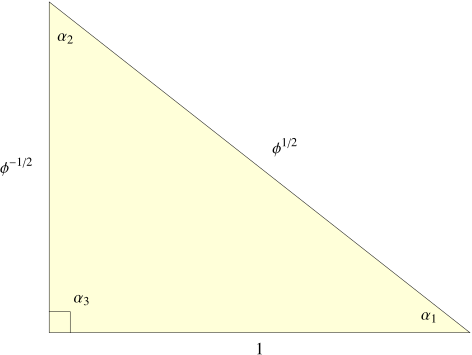
The Kepler triangle is a triangle with side lengths in the ratio  , where
 is the golden ratio. It
is therefore a reciprocal proportion
triangle. Surprisingly, it is also a right triangle,
which follows from the identity
 |
(1)
|
The Kepler triangle with side lengths  , 1, and
 has angles
 |  |  |
(2)
|
 |  |  |
(3)
|
 |  |  |
(4)
|
and area
 |
(5)
|
The altitude to the hypotenuse divides a Kepler triangle into two similar triangles
with areas  and
 times that of the parent.
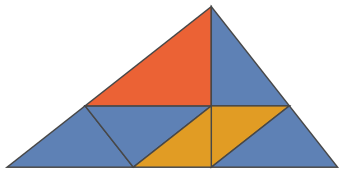
The number of dissections of a generic right triangle into seven smaller similar triangles is 2346. At the Kepler proportions, two generic layouts coalesce into a single configuration, reducing the count to 2345. The exceptional seven-piece dissection is illustrated above (E. Pegg, Jr., pers. comm., Sep. 28, 2026).

 Pegg, E. Jr. Mathematical Games. Episode
46: "Sporadic Similar Triangles." Oct. 22, 2026.