


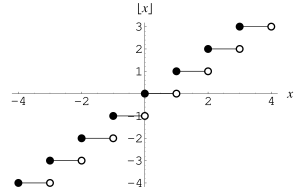
The floor function  ,
also called the greatest integer function or integer value (Spanier and Oldham 1987),
gives the largest integer less than or equal to
,
also called the greatest integer function or integer value (Spanier and Oldham 1987),
gives the largest integer less than or equal to  . The name and symbol for the floor function
were coined by K. E. Iverson (Graham et al. 1994).
. The name and symbol for the floor function
were coined by K. E. Iverson (Graham et al. 1994).
Unfortunately, in many older and current works (e.g., Honsberger 1976, p. 30; Steinhaus 1999, p. 300; Shanks 1993; Ribenboim 1996; Hilbert and Cohn-Vossen
1999, p. 38; Hardy 1999, p. 18), the symbol ![[x]](/images/equations/FloorFunction/Inline3.svg) is used instead of
is used instead of  (Graham et al. 1994, p. 67). In fact, this
notation harks back to Gauss in his third proof of quadratic reciprocity in 1808.
However, because of the elegant symmetry of the floor function and ceiling
function symbols
(Graham et al. 1994, p. 67). In fact, this
notation harks back to Gauss in his third proof of quadratic reciprocity in 1808.
However, because of the elegant symmetry of the floor function and ceiling
function symbols  and
and ![[x]](/images/equations/FloorFunction/Inline6.svg) ,
and because
,
and because ![[x]](/images/equations/FloorFunction/Inline7.svg) is such a useful symbol when interpreted as an Iverson
bracket, the use of
is such a useful symbol when interpreted as an Iverson
bracket, the use of ![[x]](/images/equations/FloorFunction/Inline8.svg) to denote the floor function should be deprecated. In this work, the symbol
to denote the floor function should be deprecated. In this work, the symbol ![[x]](/images/equations/FloorFunction/Inline9.svg) is used to denote the nearest
integer function since it naturally falls between the
is used to denote the nearest
integer function since it naturally falls between the  and
and ![[x]](/images/equations/FloorFunction/Inline11.svg) symbols.
symbols.
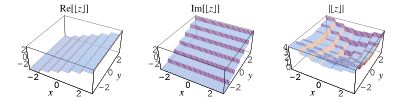
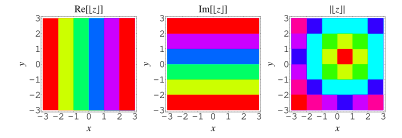
The floor function is implemented in the Wolfram Language as Floor[z],
where it is generalized to complex values of  as illustrated above.
Since usage concerning fractional part/value and integer part/value can be confusing, the following table gives a summary of names and notations used. Here, S&O indicates Spanier and Oldham (1987).
| notation | name | S&O | Graham et al. | Wolfram Language |
![[x]](/images/equations/FloorFunction/Inline13.svg) | ceiling function | -- | ceiling, least integer | Ceiling[x] |
 | congruence | -- | -- | Mod[m, n] |
 | floor function |  | floor, greatest integer, integer part | Floor[x] |
 | fractional value |  | fractional
part or  | SawtoothWave[x] |
 | fractional part |  | no name | FractionalPart[x] |
 | integer part |  | no name | IntegerPart[x] |
 | nearest integer function | -- | -- | Round[x] |
 | quotient | -- | -- | Quotient[m, n] |
The floor function satisfies the identity
 |
(1)
|
for all integers  .
.
A number of geometric-like sequences with a floor function in the numerator can be done analytically. For instance, sums of the form
 |
(2)
|
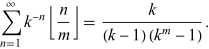
can be done analytically for rational  . For
. For  a unit fraction,
 |
(3)
|
Sums of this form lead to Devil's staircase-like behavior.
For irrational  ,
continued fraction convergents
,
continued fraction convergents  , and
, and 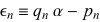 ,
,
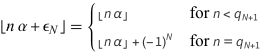 |
(4)
|
(Borwein et al. 2004, p. 12). This leads to the rather amazing result relating sums of the floor function of multiples of  to the continued fraction
of
to the continued fraction
of  by
by
 |
(5)
|
(Mahler 1929; Borwein et al. 2004, p. 12).

 ) and Fractional-Value frac(
 ) Functions." Ch. 9 in