

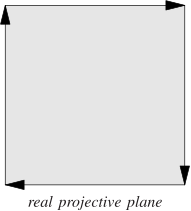
The real projective plane is the closed topological manifold, denoted  , that is obtained by projecting the points of a
plane
 from a fixed point
 (not on the plane), with the addition of the line
at infinity. It can be described by connecting the sides of a square in the orientations
illustrated above (Gardner 1971, pp. 15-17; Gray 1997, pp. 323-324).
There is then a one-to-one correspondence between points in  and lines through
 not parallel to
 . Lines through
 that are parallel to
 have a one-to-one correspondence with points on the line
at infinity. Since each line through
 intersects the sphere
 centered at
 and tangent to
 in two antipodal points,
 can be described as a quotient space of
 by identifying any two such points. The real projective
plane is a nonorientable surface. The equator
of
 (which, in the quotient space, is itself a projective
line) corresponds to the line at infinity.
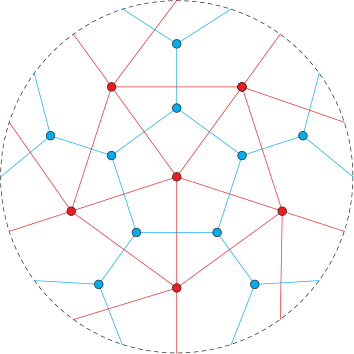
The complete graph  on six vertices can be drawn
in the real projective plane without crossings, as illustrated above. The dashed
circle bounds a disk with opposite
boundary points identified,
so a graph edge that reaches the boundary
continues at the opposite point. This drawing is the skeleton of the hemi-icosahedron.
Its dual map is the hemi-dodecahedron,
whose skeleton is the Petersen
graph.
The Boy surface, cross-cap, and Roman surface are all homeomorphic to the real
projective plane and, because  is nonorientable, these surfaces contain self-intersections
(Kuiper 1961, Pinkall 1986).

 ." Comment. Math. Helv. 35, 85-92, 1961.Pinkall,
U.