

The projective plane crossing number of a graph  is the minimum number of crossings
with which
is the minimum number of crossings
with which  can be drawn on the real
projective plane. Following the convention of putting the surface
in the subscript, it is denoted
can be drawn on the real
projective plane. Following the convention of putting the surface
in the subscript, it is denoted  , where
  denotes the real projective
plane. Variants in the literature include
denotes the real projective
plane. Variants in the literature include  ,
,  ,
,  , and
, and  (Schaefer 2026). DeVos et al. (2011) use
  when organizing crossing numbers for nonorientable
surfaces into a crossing sequence. A graph with projective
plane crossing number 0 is called a projective
planar graph.
when organizing crossing numbers for nonorientable
surfaces into a crossing sequence. A graph with projective
plane crossing number 0 is called a projective
planar graph.
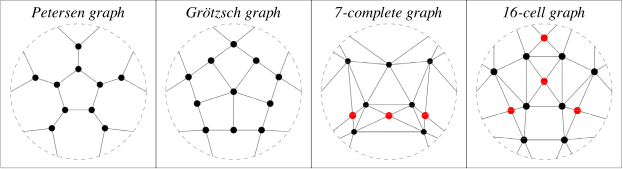
In the figure above, the real projective plane is represented by a disk in which each pair of antipodal
points on the boundary is identified. A graph
edge that reaches the dashed boundary continues
from the corresponding antipode, and red points mark
crossings. The Petersen graph and Grötzsch
graph are shown without crossings and are therefore projective
planar graphs. The drawings are crossing-minimal: the projective plane crossing
numbers of the Petersen graph, Grötzsch
graph, complete graph  , and 16-cell graph are
0, 0, 3, and 4, respectively.
, and 16-cell graph are
0, 0, 3, and 4, respectively.
For a graph, drawing on the sphere is equivalent to drawing in the plane, but drawing on the
real projective plane is not. On the other
hand, every drawing in the plane can be placed inside a
disk on the real projective
plane, so  . The additional freedom comes from the
cross-cap; in particular, either graph
edge at a single crossing in the plane can instead
be routed through the cross-cap to remove that crossing.
. The additional freedom comes from the
cross-cap; in particular, either graph
edge at a single crossing in the plane can instead
be routed through the cross-cap to remove that crossing.
All graphs with graph crossing number 0 or 1 (i.e., planar and singlecross graphs) have projective plane crossing number 0.
Neither projective plane crossing number 0 nor toroidal crossing number 0 implies the other, and either crossing number can be arbitrarily large while the other is 0 (Riskin 1993, Gitler et al. 2008).
By iterating a result of DeVos et al. (2011, Prop. 1.6), if a disconnected graph  , where
  , is the graph disjoint
union of graphs
, is the graph disjoint
union of graphs  ,
,  , and
, and  , then
 |
Here  denotes the graph crossing number, and the
sum ranges over
denotes the graph crossing number, and the
sum ranges over  . Thus an optimal drawing can be chosen in which
no graph edge of one
. Thus an optimal drawing can be chosen in which
no graph edge of one  crosses a graph edge of another
 .
For example, the formula gives
.
For example, the formula gives  ,
,  , and
, and  .
.
The projective plane crossing numbers of the complete graphs  for
for  , 2, ..., 10 are 0, 0, 0, 0, 0, 0, 3, 9, 18, and 30, respectively
(Koman 1969).
, 2, ..., 10 are 0, 0, 0, 0, 0, 0, 3, 9, 18, and 30, respectively
(Koman 1969).
Richter and Širáň (1996) computed the crossing number of the complete bipartite graph  on an arbitrary surface.
Ho (2005) showed that the projective plane crossing number of
on an arbitrary surface.
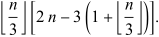
Ho (2005) showed that the projective plane crossing number of  is given by
![cr_(N_1)(K_(4,n))=|_n/3_|[2n-3(1+|_n/3_|)],](/images/equations/ProjectivePlaneCrossingNumber/NumberedEquation2.svg) |
where  is the floor function. For
  , 2, ..., the first few values are therefore 0, 0, 0, 2,
4, 6, 10, 14, 18, 24, ... (OEIS A128422).
, 2, ..., the first few values are therefore 0, 0, 0, 2,
4, 6, 10, 14, 18, 24, ... (OEIS A128422).

 on the Real Projective Plane." Disc. Math. 304,
23-33, 2005.
on the Real Projective Plane." Disc. Math. 304,
23-33, 2005.  in a Surface." J. Graph Th. 21, 51-54,
1996.Riskin, A. "The Projective Plane Crossing Number of
in a Surface." J. Graph Th. 21, 51-54,
1996.Riskin, A. "The Projective Plane Crossing Number of  ." J. Graph Th. 17, 683-693,
1993.
." J. Graph Th. 17, 683-693,
1993.