


An integral graph, not to be confused with an integral drawing of a graph, is a graph
whose graph spectrum consists entirely of integers.
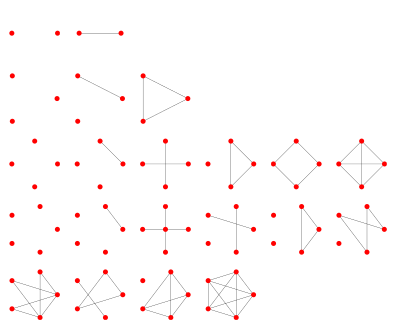
The notion was first introduced by Harary and Schwenk (1974). The numbers of simple
integral graphs on  , 2, ... nodes
are 1, 2, 3, 6, 10, 20, 33, 71, ... (OEIS A077027),
illustrated above for small
 .
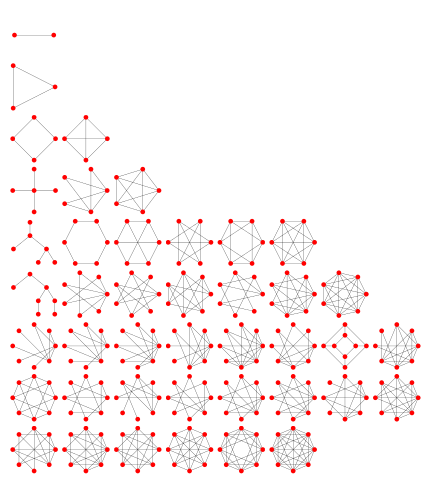
The numbers of connected simple integral graphs on  , 2, ... nodes
are 1, 1, 1, 2, 3, 6, 7, 22, 24, 83, ... (OEIS A064731),
illustrated above for small
 .
Braga et al. (2026a) proved that every simple graph having a pendant path with at least three
edges has a graph eigenvalue
in ![(1,2cos(pi/9)]](/images/equations/IntegralGraph/Inline5.svg) and another in
 . Consequently, every such graph
is nonintegral. The positive interval
is best possible for real symmetric
matrices with such a terminal path. Sharpness for
adjacency matrices of simple
graphs is not asserted (Braga et al. 2026a).
The following table lists common graph classes and their members which are integral.
| graph | integral for  of the form |
| antiprism graph | 3 |
complete
graph  | all |
cycle
graph  | 2, 3, 4, 6 |
| empty graph | all |
| prism graph | 3, 4, 6 |
star graph  |  |
wheel
graph  | 4 |
The following table lists some special named graphs that are integral and gives their spectra.


 -simplex









Among connected unicyclic graphs, the triangle graph  is the only nonbipartite
integral graph (Braga et al. 2026b).
