


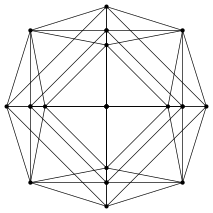
The 24-cell is a finite regular four-dimensional polytope with Schläfli symbol  . It is also known as the hyperdiamond or icositetrachoron,
and is composed of 24 octahedra, with 3 to an polytope
edge. The 24-cell has 24 vertices and 96 edges. It is one of the six regular
polychora.
. It is also known as the hyperdiamond or icositetrachoron,
and is composed of 24 octahedra, with 3 to an polytope
edge. The 24-cell has 24 vertices and 96 edges. It is one of the six regular
polychora.
The 24-cell is self-dual, and is the unique regular convex polychoron which has no direct three-dimensional analog.
The vertices of the 24-cell with circumradius  and polytope
edge length
and polytope
edge length  are given by the permutations of
 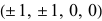 (Coxeter 1969, p. 404). There are 4 distinct
nonzero distances between vertices
of the 24-cell in 4-space.
(Coxeter 1969, p. 404). There are 4 distinct
nonzero distances between vertices
of the 24-cell in 4-space.
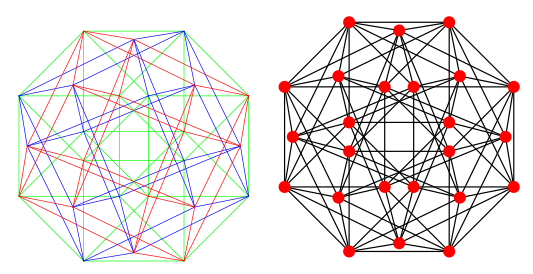
The 96 edges of the 24-cell can be partitioned into three tesseracts, as illustrated above.
The even coefficients of the D4 lattice are 1, 24, 24, 96, ... (OEIS A004011), and the 24 shortest vectors in this lattice form the 24-cell (Coxeter 1973, Conway and Sloane 1993, Sloane and Plouffe 1995).
The 24-cell graph is the skeleton of the 24-cell.
The 24-cell has
 |
distinct nets (Buekenhout and Parker 1998).
One construction for the 24-cell evokes comparison with the rhombic dodecahedron. Given two equal cubes, we construct this dodecahedron by cutting one cube into six congruent square pyramids, and attaching these to the six squares bounding the other cube. Similarly, given two equal tesseracts, the 24-cell can be constructed by cutting one tesseract into eight congruent cubic pyramids, and attaching these to the eight cubes bounding the other tesseract.
The regular 24-cell is a four-dimensional parallelohedron. Novaga and Song (2026) proved that every four-dimensional parallelohedron
of volume  and boundary surface area
  satisfies
 |
with equality iff it is similar to the regular 24-cell. Thus the regular 24-cell uniquely minimizes boundary surface area at fixed volume within this class. The result does not assert minimality among arbitrary space-filling regions. Novaga and Song (2026) report using ChatGPT to explore alternative final-step arguments and to provide editorial feedback. They state that none of the alternatives improved their original approach.

 ." Disc. Math. 186, 69-94, 1998.Conway,
J. H. and Sloane, N. J. A.
." Disc. Math. 186, 69-94, 1998.Conway,
J. H. and Sloane, N. J. A.