


The feedback vertex set number, also known as the decycling number (Bau and Beineke 2007), is the size of a smallest feedback vertex
set, i.e., a set of vertices which, when removed from the graph (together with
any adjacent edges), produces an acyclic graph.
It is variously denoted  (Bau and Beineke 2002) or
  (Pike and Zhou 2005, Bau 2007).
Every acyclic graph therefore has feedback vertex set number 0.
The feedback vertex number for a connected graph satisfies
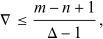 |
where  is the vertex count,
  the edge count, and
  the maximum vertex
degree (Bau 2007).
the maximum vertex
degree (Bau 2007).
Finding the feedback vertex set number of an undirected graph with vertex count  can be solved in time
  (Fomin and Villanger 2010).
The feedback vertex set numbers are known for some families of graphs, as summarized in the following table, where ![[x]](/images/equations/FeedbackVertexSetNumber/Inline8.svg) denotes the ceiling function
denotes the ceiling function  the floor function, and
  the graph Cartesian
product.
the graph Cartesian
product.
| family |  | references |
antiprism graph 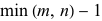 |  | |
book graph  | 1 | |
cocktail party graph  |  | |
complete
bipartite graph  |  | |
complete graph  |  | |
complete k-partite graph  | 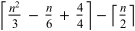 | |
complete tripartite
graph  |  | |
cycle
graph  | 1 | trivial |
empty graph  | 0 | trivial |
| gear graph | 2 | |
grid
graph  | ![[(n^2)/3-n/6+4/4]-[n/2]](/images/equations/FeedbackVertexSetNumber/Inline28.svg) | Alkauskas (2022) |
grid
graph  | closed forms know for  and some other cases and some other cases | Bau and Beineke (2002), Bau (2007) |
| Hanoi graph |  | |
| helm graph | 2 | |
ladder graph  |  | Bau and Beineke (2002), Bau (2007) |
Möbius ladder  |  | |
path
graph  | 0 | trivial |
prism graph 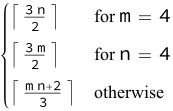 |  | |
rook graph  |  | |
star
graph  | 0 | trivial |
torus grid graph  | ![{[(3n)/2] for m=4; [(3m)/2] for n=4; [(mn+2)/3] otherwise](/images/equations/FeedbackVertexSetNumber/Inline43.svg) | trivial |
| trapezohedral graph | 3 | |
wheel graph  | 2 |

 Board without Cycles." 2022.