

The Weber modular functions are the three functions  ,
 , and
 defined on the upper half-plane
by
 |  | 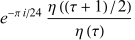 |
(1)
|
 |  |  |
(2)
|
 |  |  |
(3)
|
where  is the Dedekind eta function (Schertz 2002,
p. 326). Their values at imaginary quadratic arguments provide relatively simple
defining polynomials for class
fields (Yui and Zagier 1997, p. 1645).
Writing  and
 ,
their infinite products are
 |  | 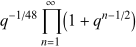 |
(4)
|
 |  | 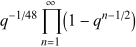 |
(5)
|
 |  | 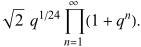 |
(6)
|
Here  is the square of the nome used in the theory of Jacobi
theta functions (Yui and Zagier 1997, p. 1646).
The functions satisfy
 |  |  |
(7)
|
 |  |  |
(8)
|
(Borwein and Borwein 1987, p. 69). They are related to the j-function by
 |
(9)
|
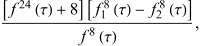
The related functions  and
 are defined by
 |  |  |
(10)
|
 |  |  |
(11)
|
and satisfy  and
 (Atkin and Morain 1993; Schertz 2002, p. 326).
Letting  be a root of unity, the transformation identities
are
 |  |  |
(12)
|
 |  |  |
(13)
|
 |  |  |
(14)
|
 |  |  |
(15)
|
 |  |  |
(16)
|
 |  |  |
(17)
|
Thus the full modular group Gamma permutes the three functions up to roots of unity (Yui and Zagier 1997, pp. 1646-1647). They are also related to the Ramanujan g- and G-functions and the elliptic lambda function.
For a negative fundamental discriminant  with
 , the value
 satisfies
 |
(18)
|
where  and
 are algebraic integers in the real subfield
of the Hilbert class field of
 . When this imaginary
quadratic field has class number one,
 and
 are ordinary integers. In particular,
for the Heegner numbers
 listed below,
 is the unique real root
of the corresponding minimal polynomial
(Yui and Zagier 1997, pp. 1660-1661).
 |  |  | minimal polynomial |
| 11 | 1 | 1 |  |
| 19 | 0 | -1 |  |
| 43 | 1 | 0 |  |
| 67 | 1 | -1 |  |
| 163 | 3 | 2 |  |
The infinite product for  gives the expansion
 |
(19)
|
Consequently, if 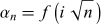 for positive
 , then
 |
(20)
|
as  .
For
 ,
this explains the approximation of the Ramanujan
constant by
 .
The value  is also related to a continued fraction studied
by Brillhart (Churchhouse and Muir 1969, p. 318; Stark 1971, p. 21). Its
translate
 is the unique real root of
 |
(21)
|
whose polynomial discriminant is  . The continued
fraction begins
 |
(22)
|
Writing  ,
its unusually large partial quotients include
 and
 (Stark 1971, p. 21). The continued
fraction of
 has the same partial quotients from
 onward, with initial term 5 instead of 3.
