


A Heegner number is a positive integer  that is squarefree and for
which the imaginary quadratic field
that is squarefree and for
which the imaginary quadratic field  has class
number one. Equivalently, the ring of integers
has class
number one. Equivalently, the ring of integers  is a principal
ideal domain and hence a unique factorization
domain. For
is a principal
ideal domain and hence a unique factorization
domain. For  and 2, the ring of integers is
![O_K=Z[sqrt(-d)].](/images/equations/HeegnerNumber/NumberedEquation1.svg) |
(1)
|
For the other Heegner numbers, all of which are congruent to 3 modulo 4, the ring of integers is
 |
(2)
|
The determination of the Heegner numbers is called Gauss's class number problem. There are exactly nine: 1, 2, 3, 7, 11, 19, 43, 67, and
163 (OEIS A003173). Their corresponding fundamental discriminants are  ,
,  ,
,
 ,
,  ,
,  ,
,
 ,
,  ,
,  , and
, and  , respectively. Heilbronn and Linfoot (1934) showed that
any additional value would have to exceed
, respectively. Heilbronn and Linfoot (1934) showed that
any additional value would have to exceed  . Heegner (1952) proved that the list was complete, although
his proof was not accepted as complete at the time (Meyer 1970). The result was subsequently
established independently by Baker (1966) and Stark (1967), and later examination
showed Heegner's proof to be essentially correct (Conway and Guy 1996).
. Heegner (1952) proved that the list was complete, although
his proof was not accepted as complete at the time (Meyer 1970). The result was subsequently
established independently by Baker (1966) and Stark (1967), and later examination
showed Heegner's proof to be essentially correct (Conway and Guy 1996).
For  ,
7, 11, 19, 43, 67, or 163, write
,
7, 11, 19, 43, 67, or 163, write  , where
  and
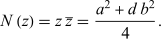
and  have the same parity. The field
norm of
have the same parity. The field
norm of  is
is
 |
(3)
|
If  is an ordinary prime number, then
  is a prime element of
  . The converse does not hold: an inert
rational prime number
. The converse does not hold: an inert
rational prime number  remains a prime element of
 , but has
  . The illustrations below therefore show the elements
whose norms are ordinary prime numbers, rather than
all prime elements.
. The illustrations below therefore show the elements
whose norms are ordinary prime numbers, rather than
all prime elements.
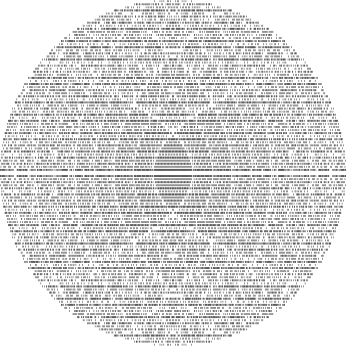
The elements whose norms are ordinary prime numbers for  are illustrated above (Pegg 2026). Since their imaginary
parts are integer multiples of
are illustrated above (Pegg 2026). Since their imaginary
parts are integer multiples of  , the points lie in horizontal
rows. Drawing each element as a narrow rectangle makes
consecutive values that are prime in a row join into
the visible "barcode." The boundary circle is
the norm bound used to select the plotted elements, not an additional arithmetic
structure.
, the points lie in horizontal
rows. Drawing each element as a narrow rectangle makes
consecutive values that are prime in a row join into
the visible "barcode." The boundary circle is
the norm bound used to select the plotted elements, not an additional arithmetic
structure.
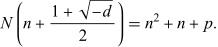
More specifically, if  ,
then
,
then
 |
(4)
|
For  this gives
  ,
so the 40 consecutive values that are prime for
,
so the 40 consecutive values that are prime for  , 1, ..., 39 appear as an uninterrupted
bar in the first nonreal row. Replacing
, 1, ..., 39 appear as an uninterrupted
bar in the first nonreal row. Replacing  by
by  gives Euler's prime-generating
polynomial
gives Euler's prime-generating
polynomial  .
The same construction for
.
The same construction for  gives
gives  .
.
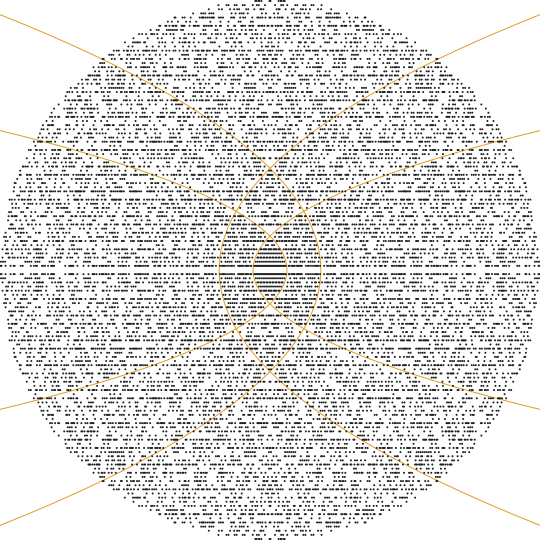
The  illustration above also shows exact parabolas from Pegg's
construction that contain no elements whose norms are prime.
In fact, for
illustration above also shows exact parabolas from Pegg's
construction that contain no elements whose norms are prime.
In fact, for  and 3, the parabolas
  satisfy
 |
(5)
|
Consequently, lattice points on these parabolas for which the expression on the right is an integer greater than one have square norm, so the norm is a composite number. The Wolfram Language implementation ResourceFunction["HeegnerPrime"] provides another way to compute prime elements in these rings (Pegg 2021).
The Heegner numbers also have connections with other striking results in prime number theory. In particular, the j-function provides connections between e, pi, and algebraic integers.
For  ,
19, 43, 67, and 163, the values
,
19, 43, 67, and 163, the values  of the Weber
modular function have minimal
polynomials of polynomial degree 3. Their
24th powers provide close approximations to
of the Weber
modular function have minimal
polynomials of polynomial degree 3. Their
24th powers provide close approximations to  (Yui and Zagier 1997, pp. 1660-1661).

 Pegg, E. Jr. "HeegnerPrime." Wolfram Function Repository,
2021.
Pegg, E. Jr. "HeegnerPrime." Wolfram Function Repository,
2021.