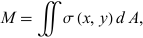
The geometric centroid of a region is the arithmetic mean position of its points. It depends only on the geometry of the region and coincides with its center of mass when the density is uniform. For a two-dimensional planar lamina of area
 |
(1)
|
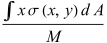
the coordinates of the geometric centroid are
 |  |  |
(2)
|
 |  |  |
(3)
|
The centroid of a uniform-density lamina is the point on which it would balance when placed on a needle. Similarly, the centroid of a uniform-density solid is the point on which the solid would "balance."
The geometric centroid of a region can be computed in the Wolfram Language using RegionCentroid[reg].
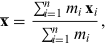
The centroid of a set of 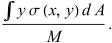 points located at positions
  is
is
 |
(4)
|
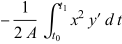
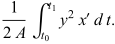
For a closed lamina of uniform density with boundary specified by  for
for ![t in [t_0,t_1]](/images/equations/GeometricCentroid/Inline10.svg) and the lamina on the left as the curve is traversed,
Green's theorem can be used to compute the centroid
as
and the lamina on the left as the curve is traversed,
Green's theorem can be used to compute the centroid
as
 |  |  |
(5)
|
 |  |  |
(6)
|
The positions of the geometric centroid of a planar non-self-intersecting polygon with vertices  , ...,
  are
are
 |  |  |
(7)
|
 | 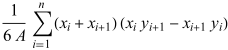 |  |
(8)
|
where  is the polygon area and
 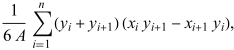 and
and  (Bourke 1988, Nürnberg 2013).
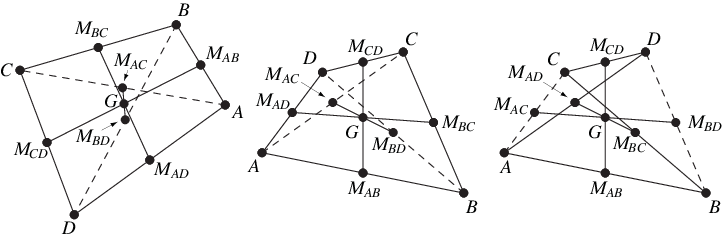
The centroid of the vertices of a quadrilateral occurs at the point of intersection of the bimedians (i.e., the lines  and
and  joining pairs of opposite midpoints)
(Honsberger 1995, pp. 36-37). In addition, it is the midpoint
of the line
joining pairs of opposite midpoints)
(Honsberger 1995, pp. 36-37). In addition, it is the midpoint
of the line  connecting the midpoints of the diagonals
  and
and  (Honsberger 1995, pp. 39-40).
Given an arbitrary hexagon, connecting the centroids of each consecutive three sides gives the so-called centroid hexagon, a hexagon with equal and parallel sides (Wells 1991).
The centroid of a semicircle of radius  is given by
 |
(9)
|
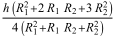
The centroids of several common laminas bounded by the following curves along the nonsymmetrical axis are summarized in the following table.


In three dimensions, a solid has volume
 |
(10)
|
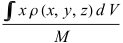
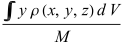
and the coordinates of its geometric centroid are
 |  |  |
(11)
|
 |  |  |
(12)
|
 |  |  |
(13)
|


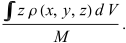
 ,
,  ,
,