

The solid angle  subtended by a surface
 is defined as the surface area
 of a unit
sphere covered by the surface's projection onto the
sphere. This can be written as
 |
(1)
|
where  is a unit
vector from the origin,
 is the differential area of a surface
patch, and
 is the distance from the origin
to the patch. Written in spherical coordinates
with
 the colatitude
(polar angle) and
 for the longitude (azimuth),
this becomes
 |
(2)
|
Solid angle is measured in steradians, and the solid angle corresponding to all of space being subtended is  steradians.
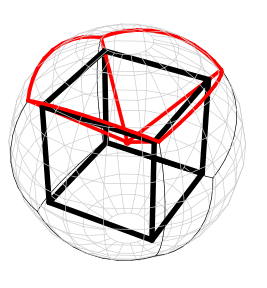
To see how the solid angle of simple geometric shapes can be computed explicitly, consider the solid angle  subtended by one face of a cube of side length
 centered at the origin. Since
the cube is symmetric and
has six sides, one side obviously subtends
 steradians. To compute
this explicitly, rewrite (1) in Cartesian
coordinates using
 |  |  |
(3)
|
 |  |  |
(4)
|
and
 |  |  |
(5)
|
 |  |  |
(6)
|
Considering the top face of the cube, which is located at  and has sides parallel the
 - and
 -axes,
 |  |  |
(7)
|
 |  |  |
(8)
|
as expected.
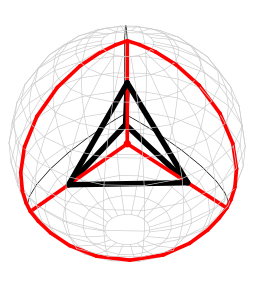
Similarly, consider a regular tetrahedron with side length  ,
the origin at its geometric
centroid, and base at
 ,
where
 is its inradius. Its bottom vertices
are at
 and
 , where
 |  |  |
(9)
|
 |  |  |
(10)
|
 |  |  |
(11)
|
Then  runs from
 to
 ,
and for the half of the base in the positive
 half-plane,
 can be taken to run from 0 to
 , giving
 |  |  |
(12)
|
 |  |  |
(13)
|
i.e.,  ,
as expected.
