TOPICS
Search

Simple Polyhedron


The term simple polyhedron has two distinct meanings, one combinatorial and the other geometric.

In the combinatorial sense, a simple polyhedron is a bounded three-dimensional convex polyhedron with exactly three faces meeting at each vertex. This is the three-dimensional case of a simple polytope. Its dual polyhedron is a three-dimensional simplicial polytope, meaning that all its faces are triangles (Fukuda 2004). Equivalently, every vertex figure is a triangle, which is a 2-simplex (Renner 2009). This is a local condition at each polyhedron vertex. It does not require the whole polyhedron to be a tetrahedron, the three-dimensional simplex.

In the geometric sense, a simple polyhedron is a polyhedron with no voids or self-intersections of its boundary. The solid is homeomorphic to a closed ball, and its boundary is homeomorphic to a sphere. The Wolfram Language function SimplePolyhedronQ[poly] tests this geometric condition, and the class returned by PolyhedronData["Simple"] uses this sense. It does not impose the three-face condition at vertices.

The cube is simple in both senses. The regular octahedron and regular icosahedron are simple in the geometric sense, but have four and five faces, respectively, meeting at each polyhedron vertex. They are therefore not simple in the combinatorial sense.

An acoptic polyhedron has no self-intersections, but this condition allows toroidal polyhedra, such as the Császár polyhedron (Grünbaum 1999). Acoptic is therefore not a synonym for either meaning of simple.

The enumeration below uses the combinatorial definition.

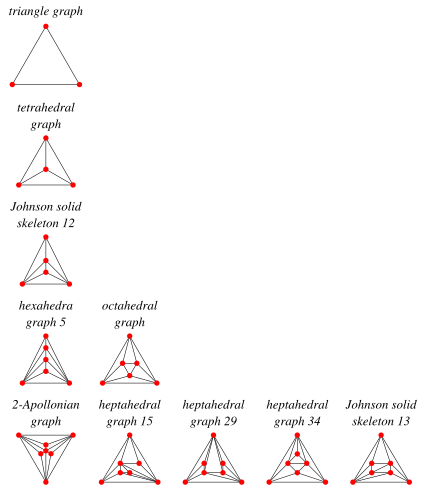
The numbers of combinatorially distinct simple polyhedra with n=4, 5, ... faces are 1, 1, 2, 5, 14, 50, 233, 1249, ... (OEIS A000109). Equivalently, these count simplicial polyhedra with n vertices.

SimplePolyhedra

The skeletons of the dual simplicial polyhedra correspond to the triangulated graphs, the smallest of which are illustrated above. The illustrated three-vertex triangulation is degenerate and does not represent a polyhedron. The skeletons of the simple polyhedra themselves are cubic polyhedral graphs.


See also

Acoptic Polyhedron, Cubic Polyhedral Graph, Dual Polyhedron, Planar Graph, Simple Polygon, Simple Polytope, Simplex, Simplicial Polytope, Triangulated Graph, Vertex Figure

Explore with Wolfram|Alpha

References

Bokowski, J. and Schuchert, P. "Equifacetted 3-Spheres as Topes of Nonpolytopal Matroid Polytopes." Disc. Comput. Geom. 13, 347-361, 1995.Bowen, R. and Fisk, S. "Generation of Triangulations of the Sphere." Math. Comput. 21, 250-252, 1967. https://doi.org/10.2307/2004172.Dillencourt, M. B. "Polyhedra of Small Orders and Their Hamiltonian Properties." Tech. Rep. 92-91, Info. and Comput. Sci. Dept., Univ. Calif. Irvine, 1992.Federico, P. J. "Enumeration of Polyhedra: The Number of 9-Hedra." J. Combin. Th. 7, 155-161, 1969.Fukuda, K. "What Is Simple/Simplicial Polytope?" Aug. 26, 2004. https://www.cs.mcgill.ca/~fukuda/soft/polyfaq/node10.html.Gardner, M. "Mathematical Games: On the Remarkable Császár Polyhedron and Its Applications in Problem Solving." Sci. Amer. 232, 102-107, May 1975.Grünbaum, B. "Acoptic Polyhedra." In Advances in Discrete and Computational Geometry (Ed. B. Chazelle, J. E. Goodman, and R. Pollack). Providence, RI: American Mathematical Society, pp. 163-199, 1999. https://doi.org/10.1090/conm/223/03137.Grünbaum, B. Convex Polytopes. New York: Wiley, p. 424, 1967.Lederberg, J. "Hamilton Circuits of Convex Trivalent Polyhedra (up to 18 Vertices)." Amer. Math. Monthly 74, 522-527, 1967.Renner, L. E. "Descent Systems for Bruhat Posets." J. Algebraic Combin. 29, 413-435, 2009. https://doi.org/10.1007/s10801-008-0141-4.Wolfram Research. "PolyhedronData." https://reference.wolfram.com/language/ref/PolyhedronData.html.Wolfram Research. "SimplePolyhedronQ." https://reference.wolfram.com/language/ref/SimplePolyhedronQ.html.Sloane, N. J. A. Sequence A000109/M1469 in "The On-Line Encyclopedia of Integer Sequences."

Referenced on Wolfram|Alpha

Simple Polyhedron

Cite this as:

Weisstein, Eric W. "Simple Polyhedron." From MathWorld--A Wolfram Resource. https://mathworld.wolfram.com/SimplePolyhedron.html

Subject classifications