

Trigonometry is the study of angles and of the angular relationships of planar and three-dimensional figures. The trigonometric
functions (also called circular functions) comprising trigonometry are the cosecant  , cosine
  , cotangent
  , secant
  , sine
  , and tangent
  . The inverses of these functions are denoted
  ,
,  ,
,  ,
,  ,
,  , and
, and  . Note that the
  notation here means inverse
function, not
notation here means inverse
function, not  to the
  power.
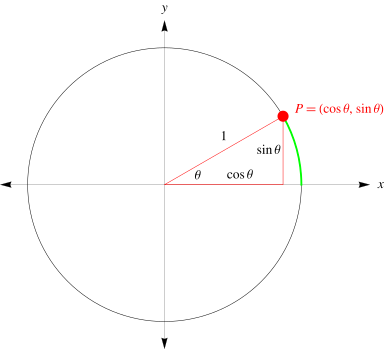
The trigonometric functions are most simply defined using the unit circle. Let  be an angle measured counterclockwise
from the x-axis along an arc
of the circle. Then
be an angle measured counterclockwise
from the x-axis along an arc
of the circle. Then  is the horizontal coordinate of the arc
endpoint, and
is the horizontal coordinate of the arc
endpoint, and  is the vertical component. The ratio
  is defined as
  . As a result of this definition, the trigonometric
functions are periodic with period
. As a result of this definition, the trigonometric
functions are periodic with period  , so
, so
 |
(1)
|
where  is an integer and func is a trigonometric
function.
is an integer and func is a trigonometric
function.
Replacing the unit circle by a superellipse leads to the generalized subject known as squigonometry.
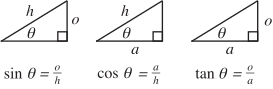
A right triangle has three sides: the hypotenuse and, relative to a given angle  , the adjacent side and
opposite side. A helpful mnemonic for remembering
the definitions of the trigonometric functions
is then given by "oh, ah, o-a," "Soh, Cah, Toa," or "SOHCAHTOA", i.e., sine equals
the opposite side over the hypotenuse,
cosine equals the adjacent
side over the hypotenuse, and tangent
equals the opposite side over the adjacent
side,
, the adjacent side and
opposite side. A helpful mnemonic for remembering
the definitions of the trigonometric functions
is then given by "oh, ah, o-a," "Soh, Cah, Toa," or "SOHCAHTOA", i.e., sine equals
the opposite side over the hypotenuse,
cosine equals the adjacent
side over the hypotenuse, and tangent
equals the opposite side over the adjacent
side,
 |  |  |
(2)
|
 |  |  |
(3)
|
 |  |  |
(4)
|
Another mnemonic probably more common in Great Britain than the United States is "Tommy On A Ship Of His Caught A Herring."
The Pythagorean identity, which follows from the Pythagorean theorem, is
 |
(5)
|
It is therefore also true that
 |
(6)
|
and
 |
(7)
|
The trigonometric functions can be defined algebraically in terms of complex exponentials (i.e., using the Euler formula) as
 |  |  |
(8)
|
 |  |  |
(9)
|
 |  |  |
(10)
|
 |  |  |
(11)
|
 |  |  |
(12)
|
 |  |  |
(13)
|
 |  |  |
(14)
|
 |  |  |
(15)
|
 |  |  |
(16)
|
 |  |  |
(17)
|
 |  |  |
(18)
|
Hybrid trigonometric product/sum formulas are
 |  |  |
(19)
|
 |  |  |
(20)
|
 |  |  |
(21)
|
 |  |  |
(22)
|
Osborn's rule gives a prescription for converting trigonometric identities to analogous identities for hyperbolic functions.
For imaginary arguments,
 |  |  |
(23)
|
 |  |  |
(24)
|
For complex arguments,
 |  |  |
(25)
|
 |  |  |
(26)
|
For the absolute square of complex arguments  ,
,
 |  |  |
(27)
|
 |  |  |
(28)
|
The complex modulus also satisfies the curious identity
 |
(29)
|
The only functions satisfying identities of this form,
 |
(30)
|
are  ,
,
 , and
, and  (Robinson 1957).
