


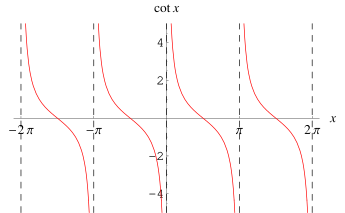
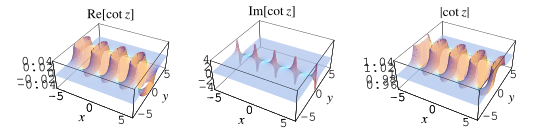
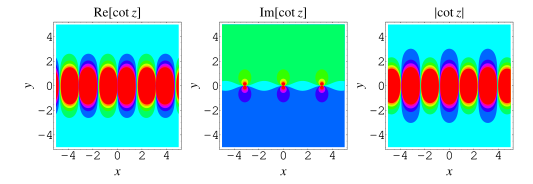
The cotangent function  is defined for
 by
 |  |  |
(1)
|
 |  |  |
(2)
|
 |  |  |
(3)
|
Equivalently,  wherever the tangent
 is finite and nonzero. The
cotangent is implemented in the Wolfram
Language as Cot[z].
The notations  (Erdélyi et al. 1981, p. 7; Jeffrey 2000, p. 111) and
 (Gradshteyn and Ryzhik 2000, p. xxix)
are sometimes used in place of
 . Note that the cotangent is
not in as widespread use in Europe as are
 ,
 ,
and
 , although it does appear explicitly in various German
and Russian handbooks (e.g., Gradshteyn and Ryzhik 2000, p. 28). Interestingly,
 is treated on par with the other
trigonometric functions in most tabulations
(Gellert et al. 1989, p. 222; Gradshteyn and Ryzhik 2000, p. 28),
while
 and
 are sometimes not (Gradshteyn and Ryzhik 2000, p. 28).
An important identity connecting the cotangent with the cosecant is given by
 |
(4)
|
The cotangent has smallest positive fixed point  such that
 at 0.8603335890... (OEIS A069855;
Bertrand 1865, p. 285).
The derivative is given by
 |
(5)
|
and the indefinite integral by
 |
(6)
|
where  is a constant
of integration and a local branch of the natural
logarithm is chosen. On a real interval between
consecutive multiples of
 ,
a real antiderivative is
 .
Definite integrals include
 |  |  |
(7)
|
 |  |  |
(8)
|
 |  |  |
(9)
|
 |  |  |
(10)
|
 |  |  |
(11)
|
 |  |  |
(12)
|
 |  |  |
(13)
|
where  is Catalan's
constant,
 is the natural logarithm of 2, and
 is Apéry's constant.
These integrals include ones considered by Glaisher (1893). Additional integrals
include
 |
(14)
|
for  , where
 is the digamma function,
and
 |
(15)
|
for  .
The Laurent series for  about the origin is
 |  |  |
(16)
|
 |  |  |
(17)
|
(OEIS A002431 and A036278), where  is a Bernoulli
number and
 .
A sum identity for the cotangent, valid for  ,
is given by
 |
(18)
|
For an integer  ,
 is rational only
for
 . In particular, the degrees of the algebraic
numbers
 for
 , 3, ... are 1, 2, 1, 4, 2, 6, 2, 6, 4, 10, 2, ...
(OEIS A089929).

 and Cotangent
 Functions." Ch. 34 in