


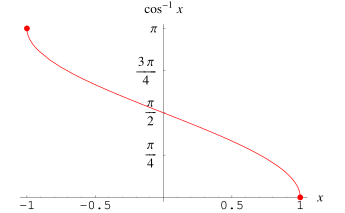
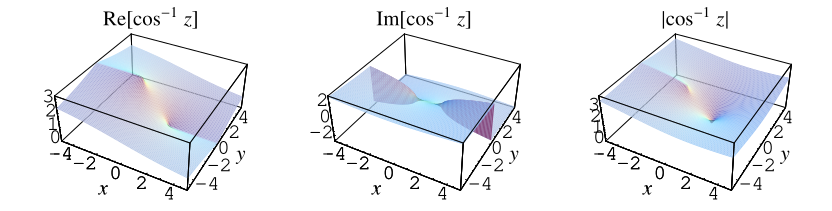
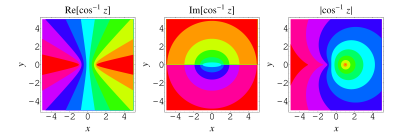
The inverse cosine is the multivalued function  (Zwillinger 1995, p. 465),
also denoted
(Zwillinger 1995, p. 465),
also denoted  (Abramowitz and Stegun 1972, p. 79; Harris and Stocker 1998, p. 307; Jeffrey
2000, p. 124), that is the inverse function
of the cosine. The variants
(Abramowitz and Stegun 1972, p. 79; Harris and Stocker 1998, p. 307; Jeffrey
2000, p. 124), that is the inverse function
of the cosine. The variants  (e.g., Beyer 1987, p. 141; Bronshtein and Semendyayev,
1997, p. 69) and
(e.g., Beyer 1987, p. 141; Bronshtein and Semendyayev,
1997, p. 69) and  are sometimes used to refer to explicit principal
values of the inverse cosine, although this distinction is not always made (e.g,.
Zwillinger 1995, p. 466). Worse yet, the notation
are sometimes used to refer to explicit principal
values of the inverse cosine, although this distinction is not always made (e.g,.
Zwillinger 1995, p. 466). Worse yet, the notation  is sometimes used for the principal value, with
  being used for the multivalued
function (Abramowitz and Stegun 1972, p. 80) Note that the notation
being used for the multivalued
function (Abramowitz and Stegun 1972, p. 80) Note that the notation  (commonly used in North America and in pocket calculators
worldwide),
(commonly used in North America and in pocket calculators
worldwide),  is the cosine and the superscript
  denotes the inverse function,
not the multiplicative inverse.
denotes the inverse function,
not the multiplicative inverse.
The principal value of the inverse cosine is implemented in the Wolfram Language as ArcCos[z] in the Wolfram Language. In the GNU C library, it is implemented as acos(double x).
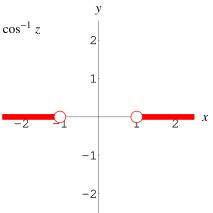
The inverse cosine is a multivalued function and hence requires a branch cut in the complex
plane, which the Wolfram Language's
convention places at the line segments  and
and  . This follows from the definition of
  as
as
 |
(1)
|
Special values include
 |  |  |
(2)
|
 |  |  |
(3)
|
 |  |  |
(4)
|
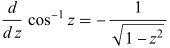
The derivative of  is given by
 |
(5)
|
and its indefinite integral is
 |
(6)
|
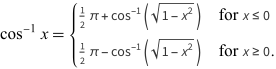
The inverse cosine satisfies
 |
(7)
|
for all complex  ,
and
,
and
 |
(8)
|
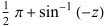
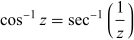
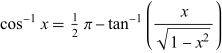
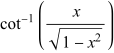
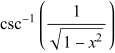
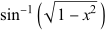
The inverse cosine is given in terms of other inverse trigonometric functions by
 |  |  |
(9)
|
 |  |  |
(10)
|
for all complex  ,
,
 |
(11)
|
for  ,
,
 |
(12)
|
for  ,
and
,
and
 |  |  |
(13)
|
 |  |  |
(14)
|
 |  |  |
(15)
|
 |  | 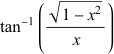 |
(16)
|
for  ,
where in the last equation, equality at zero is understood to mean in the limit as
,
where in the last equation, equality at zero is understood to mean in the limit as
 .
.
The Maclaurin series for the inverse cosine with  is
is
 |  | 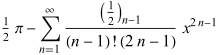 |
(17)
|
 |  |  |
(18)
|
