


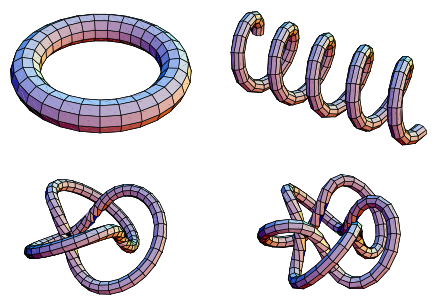
A tube of radius  of a set
 is the set of points at a distance
 from
 .
In particular, if
 is a regular space curve whose curvature does not vanish, then the normal
vector and binormal vector are perpendicular
to the tangent vector
 ,
and the circle
 is in the plane perpendicular to
 at
 . So as the circle moves around
 ,
it traces out a tube, provided the tube radius
 is small enough so that the tube is not self-intersecting.
A formula for the tube around a curve is therefore given by
 |
(1)
|
for  over the range of the curve and
 . The illustrations above show tubes
corresponding to a circle, helix,
and two torus knots.
The surface generated by constructing a tube around a circle is known as a torus.
Equivalently, a tube is the constant-radius case of a canal surface. The envelope
of the spheres centered at  with radius
 satisfies
 |  |  |
(2)
|
 |  |  |
(3)
|
The second equation makes each cross-sectional circle perpendicular to the tangent vector. For a closed
embedded spine curve and sufficiently small  , this envelope is the surface
at distance
 from the curve. At larger radii the envelope can self-intersect and need not coincide
with that distance surface.

 Bar-Natan, D. "Tube Plot Package."