


A substitution tiling is a tiling whose finite patches occur in repeated applications of replacement rules to finitely many tile types. A geometric rule expands a representative tile and partitions the result into tiles of the original types with disjoint interiors (Frank 2008).
Tile inflation enlarges a tile by a dilation and subdivides the result into tiles of the original sizes. Applying the subdivision
without the enlargement gives tile deflation, which
refines the pattern at its original overall scale. The ratio of enlarged to original
edge lengths is called the inflation factor. For
a common inflation factor  , this can be written
 |
(1)
|
where each  is an isometry placing a child tile and
  counts the children of type
  in the expanded tile of type
  . In dimension
  , the column vector
  of tile volumes satisfies
 |
(2)
|
Thus  is an eigenvalue of the nonnegative
matrix
is an eigenvalue of the nonnegative
matrix  .
More general geometric rules use an expanding linear
transformation instead of a common scale factor
(Frank 2008).
.
More general geometric rules use an expanding linear
transformation instead of a common scale factor
(Frank 2008).
Substitution does not itself imply nonperiodicity. A square subdivided into four equal squares generates a periodic tiling. The quaquaversal tiling instead gives a three-dimensional nonperiodic tiling using a triangular prism that is a rep-tile (Conway and Radin 1998). The Mosseri-Sadoc tiles provide another three-dimensional example with inflation factor equal to the golden ratio.
More general rules allow different contraction factors among children (Smilansky and Solomon 2021).
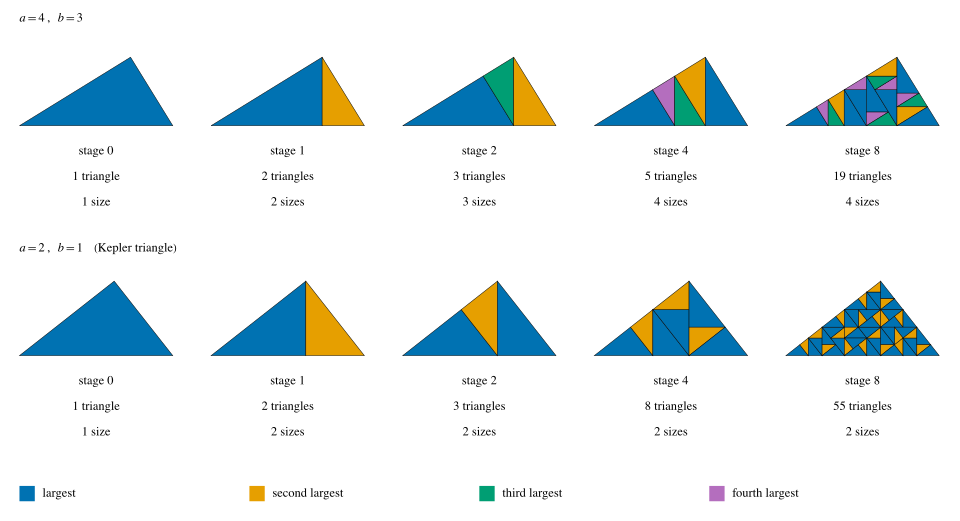
A two-piece example starts with a right triangle having side lengths in the ratio  , where
  are integers and
  satisfies
 |
(3)
|
At each stage, every currently largest triangle is split by the altitude to its hypotenuse,
and all smaller triangles are left unchanged. The two
children are similar triangles with areas  and
and  times that of their parent. The number
  of distinct sizes present at any one stage satisfies
 |
(4)
|
where  is the greatest common divisor. In particular,
 when
when  and
and  are relatively prime (E. Pegg, Jr., pers.
comm., Oct. 19, 2026). The illustration shows stages 0, 1, 2, 4, and 8 for
are relatively prime (E. Pegg, Jr., pers.
comm., Oct. 19, 2026). The illustration shows stages 0, 1, 2, 4, and 8 for  ,
,  (top) and for the Kepler
triangle,
(top) and for the Kepler
triangle,  ,
,
 (bottom). Colors distinguish sizes within each stage, from largest to smallest in
blue, orange, green, and purple.
(bottom). Colors distinguish sizes within each stage, from largest to smallest in
blue, orange, green, and purple.
More generally, fix a finite dissection of one tile into smaller similar copies with relative
measures  , ...,
  , where
  and the
  are positive integers.
The measure is length, area, or volume in the appropriate
dimension. Starting with one tile, repeatedly replace
every largest tile by this rule. Then
are positive integers.
The measure is length, area, or volume in the appropriate
dimension. Starting with one tile, repeatedly replace
every largest tile by this rule. Then
 |
(5)
|
where  and
and  .
To prove this, write each relative measure as
.
To prove this, write each relative measure as  . The exponents are multiples
of
. The exponents are multiples
of  ,
and their span remains at most
,
and their span remains at most  by mathematical induction.
If the current minimum is
by mathematical induction.
If the current minimum is  , retained exponents are at most
 ,
new ones are at most
,
new ones are at most  , and the new minimum is at least
  . Thus at most
  distinct sizes coexist.
A four-piece rule splits a selected triangle by its altitude to the hypotenuse
and then splits both children the same way, treating the entire dissection
as one replacement step. The relative child areas have exponents  ,
,  ,
,  , and
, and  , giving the bound
  .
.
These largest-first refinements are two-dimensional counterparts of Kakutani partitions. Smilansky (2020) proves a result in uniform distribution theory that applies to these refinements. Choose one point in the interior of each triangle at every stage. For any subregion of the original triangle whose boundary has area zero, the fraction of selected points in that subregion tends to its area divided by the area of the original triangle.
The following finite dissection example uses six tetrahedra (Pegg 2026), denoted here by  , ...,
  . Writing
  for the golden ratio, a
row
for the golden ratio, a
row  specifies edge lengths
 |
(6)
|
in the vertex-pair order 12, 13, 14, 23, 24, 34. The rows and numbers of children are
| type | edge exponents | children |
 |  | 13 |
 |  | 17 |
 |  | 7 |
 |  | 11 |
 |  | 8 |
 |  | 11 |
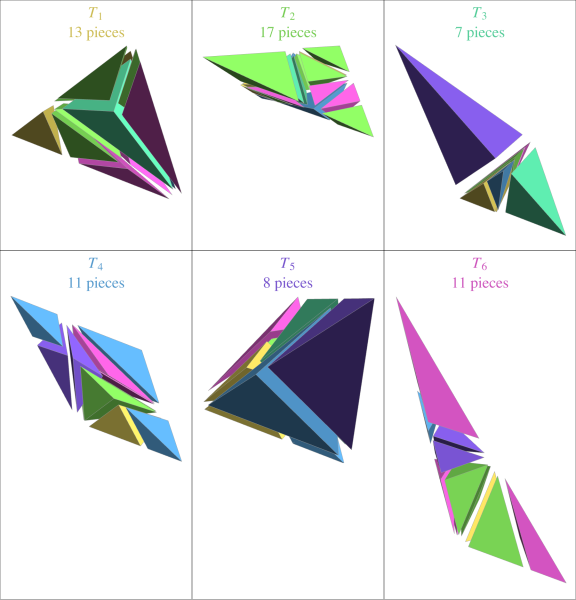
Each of the six tetrahedra is partitioned into smaller similar copies drawn from the same six types. The exploded
view separates the pieces to show the dissections,
with colors identifying types. The rules use contraction factors  with
with  drawn from 1, 2, ..., 7, so all contraction factors are powers
of
drawn from 1, 2, ..., 7, so all contraction factors are powers
of  .
The children have disjoint interiors and their union
is the parent tetrahedron, so the subdivisions can
be iterated indefinitely. Whether these rules generate a nonperiodic
tiling has not yet been established. These six shapes are distinct from the traditional
golden tetrahedra.
.
The children have disjoint interiors and their union
is the parent tetrahedron, so the subdivisions can
be iterated indefinitely. Whether these rules generate a nonperiodic
tiling has not yet been established. These six shapes are distinct from the traditional
golden tetrahedra.
The Ammann-Kramer-Neri tiling provides a three-dimensional rhombohedral example with tile deflation reducing lengths by the cube of the golden ratio (Dietl and Eschenburg 2017).

 Pegg, E. Jr. "The 3D Golden 6 Substitution System." Wolfram
Demonstrations Project. 2026.
Pegg, E. Jr. "The 3D Golden 6 Substitution System." Wolfram
Demonstrations Project. 2026.