


A quaquaversal tiling is a hierarchical substitution tiling of three-dimensional Euclidean space
introduced by Conway and Radin (1998). It is a nonperiodic
tiling whose tile is a right triangular prism
of depth 1 with base a 30-60-90
triangle with lengths 1,  , and 2. Equivalently, the triangular
prism has five unit edges, two of measure
, and 2. Equivalently, the triangular
prism has five unit edges, two of measure
 ,
and two of measure 2 (Radin 2021).
,
and two of measure 2 (Radin 2021).
The defining substitution dissects the triangular prism into eight mutually congruent copies, each
similar to the original with scale
factor  .
The children are obtained from two subdivisions of depth
.
The children are obtained from two subdivisions of depth  by rotating
two pieces of one through
by rotating
two pieces of one through  and two pieces of the other through
  about perpendicular
axes (Conway and Radin 1998). The tile is therefore a rep-tile
with
about perpendicular
axes (Conway and Radin 1998). The tile is therefore a rep-tile
with  .
After
.
After  substitutions, the original triangular prism
is partitioned into
substitutions, the original triangular prism
is partitioned into  triangular prisms, each with scale
factor
triangular prisms, each with scale
factor  and volume
  that of the original.
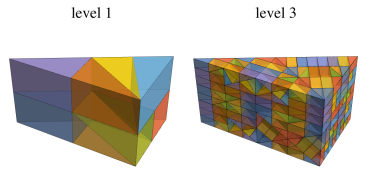
Conway and Radin (1998) combine each subdivision with a dilation by a factor of 2 and iterate about an appropriate fixed
point. In the limit, the resulting construction covers Euclidean
space. Two copies of the unmarked triangular
prism can instead be joined to form a cuboid of dimensions
 ,
so the tile also admits periodic tilings. The nonperiodicity
is therefore a property of the substitution construction rather than of the tile
as an aperiodic monotile.
,
so the tile also admits periodic tilings. The nonperiodicity
is therefore a property of the substitution construction rather than of the tile
as an aperiodic monotile.
Conway and Radin denote the rotation group generated by rotations through  and
and  about perpendicular
axes by
about perpendicular
axes by  .
The quaquaversal substitution uses
.
The quaquaversal substitution uses  . The orientations of its tiles are uniformly distributed
in the special orthogonal group
. The orientations of its tiles are uniformly distributed
in the special orthogonal group  , and the number of distinct orientations occurring in
a ball of volume
, and the number of distinct orientations occurring in
a ball of volume  grows polynomially in
  (Conway and Radin 1998). The name "quaquaversal"
was taken by Conway from geology, where it describes structures oriented in all directions
(Radin 2021).
(Conway and Radin 1998). The name "quaquaversal"
was taken by Conway from geology, where it describes structures oriented in all directions
(Radin 2021).
