


A golden tetrahedron is one of six nondegenerate tetrahedra with edges of lengths 1 and  , where
  is the golden ratio, excluding
those with four congruent faces (Ogievetsky and Papadopolos
2001). Each has equilateral triangles, golden triangles, or golden
gnomons as faces and can be oriented so that its edges
are parallel to the twofold axes
of symmetry of an icosahedron.
is the golden ratio, excluding
those with four congruent faces (Ogievetsky and Papadopolos
2001). Each has equilateral triangles, golden triangles, or golden
gnomons as faces and can be oriented so that its edges
are parallel to the twofold axes
of symmetry of an icosahedron.
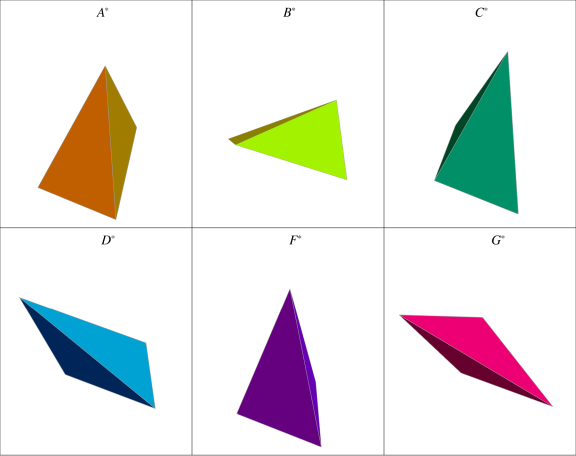
The six shapes, conventionally labeled  ,
,  ,
,  ,
,  ,
,  , and
, and  , assemble into the four Mosseri-Sadoc
tiles. Unlike those composite tiles, they do not admit a subdivision of every
, assemble into the four Mosseri-Sadoc
tiles. Unlike those composite tiles, they do not admit a subdivision of every
 -enlarged
tile into whole original tiles for any positive integer
-enlarged
tile into whole original tiles for any positive integer  . The obstruction can be proved using
the areas of their faces (Ogievetsky and Papadopolos 2001).
. The obstruction can be proved using
the areas of their faces (Ogievetsky and Papadopolos 2001).
These traditional golden tetrahedra differ from the six shapes with edge lengths given by powers of  in the example under substitution
tiling.
in the example under substitution
tiling.
