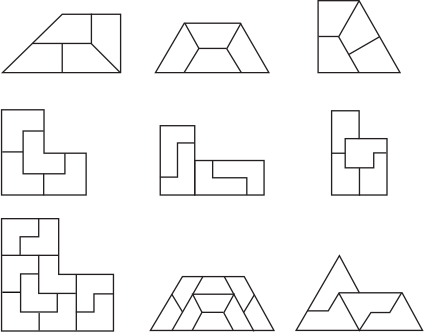
A rep-closed set with
nonempty interior that can be dissected
into congruent
smaller copies, each similar to the original set, where
integer
(Kynčl and Patáková 2017). The definition applies in any dimension ,
although rep-tiles are often illustrated by polygons .
The triangular polygonal spiral is one such example,
while certain space-filling tetrahedra
are rep-8-tiles. The Delian brick is a three-dimensional
rep-2-tile obtained by bisecting a cuboid with edge lengths in the ratio perpendicular
to its longest edges (Pegg 2018).
For polygons , allowing the smaller copies to have unequal sizes gives the more general notion of an irreptile
(Richter 2009, p. 110). For example, the two-piece golden
bee dissection uses linear scale factors golden ratio (Durand
et al. 2020).
Repeated subdivision of a rep-tile gives a geometric rule for a substitution tiling with a single tile type. Equivalently, the tile can be enlarged until
its component copies have the original size, giving a tile
inflation rule (Frank 2008).
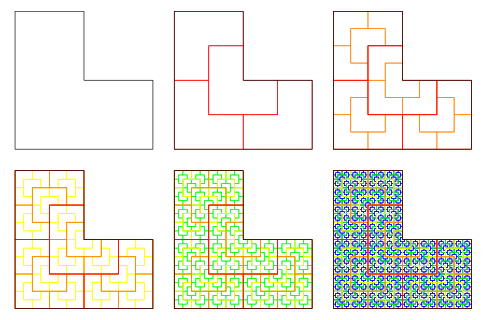
The above figure shows the zeroth through fifth iterations
obtained by rep-tiling the L-polyomino .
Panckoucke (1749, p. xxx) illustrates a dissection of an L-shaped triomino into four equal, similar
pieces. In modern terminology, this is a rep-4 dissection
with linear scale factor
Trott (2007) uses the rep-4 subdivision of the L-shaped triomino for the surface pattern of the Version 6 Spikey . The subdivided
pattern is mapped onto the faces of a dodecahedron .
See also Delian Brick ,
Dissection ,
Golden Bee ,
Irreptile ,
Polygonal Spiral ,
Quaquaversal
Tiling ,
Space-Filling Tetrahedron ,
Substitution Tiling ,
Tiling ,
Triangle Dissection ,
Triomino
Explore with Wolfram|Alpha
References Clarke, A. L. "Reptiles." http://www.recmath.com/PolyPages/PolyPages/Reptiles.htm . Durand, B.; Shen, A.; and Vereshchagin, N. "On the Structure of Ammann A2 Tilings."
Disc. Comput. Geom. 63 , 577-606, 2020. https://doi.org/10.1007/s00454-019-00074-1 . Frank,
N. P. "A Primer of Substitution Tilings of the Euclidean Plane." Expo.
Math. 26 , 295-326, 2008. https://doi.org/10.1016/j.exmath.2008.02.001 . Gardner,
M. "Rep-Tiles: Replicating Figures on the Plane." Ch. 19 in The
Unexpected Hanging and Other Mathematical Diversions. Gardner, M. "Rep-Tiles."
Ch. 5 in The
Colossal Book of Mathematics: Classic Puzzles, Paradoxes, and Problems. Kynčl, J. and
Patáková, Z. "On the Nonexistence of Elec. J. Combin. 24 , P3.1, 2017. https://doi.org/10.37236/6113 . Langford,
C. D. "Uses of a Geometric Puzzle." Math. Gaz., No. 260,
1940. Panckoucke, A.-J. Les amusemens mathématiques précédés
des élémens d'arithmétique, d'algèbre & de géométrie
nécessaires pour l'intelligence des problêmes. Lille, France: André-Joseph
Panckoucke and Paris: Tilliard, p. xxx, 1749. https://babel.hathitrust.org/cgi/pt?id=nyp.33433087564948&seq=38 . Wolfram Community. Jul. 3, 2018. https://community.wolfram.com/t/12689 .Mathematica J. 9 , 609-640, 2005. https://content.wolfram.com/sites/19/issue/v9i3.pdf .Richter,
C. "Families of Irreptiles." Elem. Math. 64 , 109-121, 2009.
https://doi.org/10.4171/em/122 . Mathematica 6 Surface-Textured
Hyperbolic Dodecahedron." Wolfram Library Archive. May 22, 2007. https://library.wolfram.com/infocenter/MathSource/6712/ .Wells,
D. The
Penguin Dictionary of Curious and Interesting Geometry. Referenced on Wolfram|Alpha Rep-Tile
Cite this as:
Weisstein, Eric W. "Rep-Tile." From MathWorld https://mathworld.wolfram.com/Rep-Tile.html
Subject classifications More... Less...


 -tile, also called an
 -reptile, is a closed set with
nonempty interior that can be dissected
into
 mutually congruent
smaller copies, each similar to the original set, where
 is an integer
(Kynčl and Patáková 2017). The definition applies in any dimension,
although rep-tiles are often illustrated by polygons.
The triangular polygonal spiral is one such example,
while certain space-filling tetrahedra
are rep-8-tiles. The Delian brick is a three-dimensional
rep-2-tile obtained by bisecting a cuboid with edge lengths in the ratio
 perpendicular
to its longest edges (Pegg 2018).
 and
 , where
 is the golden ratio (Durand
et al. 2020).

 .

 -Reptile Simplices in
 and
 ."
Elec. J. Combin. 24, P3.1, 2017.
 Pegg, E. Jr. "The Delian Brick and Other 3D Self-Similar Dissections."
Wolfram Community. Jul. 3, 2018.