


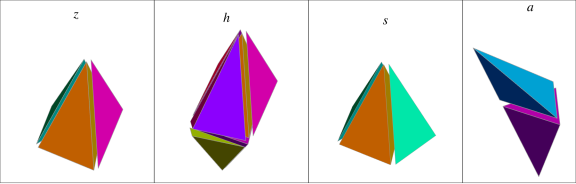
Mosseri-Sadoc tiles are four composite polyhedra, conventionally denoted  ,
,  ,
,  , and
, and  , assembled from golden tetrahedra
and used to tile three-dimensional Euclidean
space. Their constituent equilateral triangles
are internal, leaving golden triangles and golden gnomons on their boundaries (Papadopolos and
Ogievetsky 2000).
, assembled from golden tetrahedra
and used to tile three-dimensional Euclidean
space. Their constituent equilateral triangles
are internal, leaving golden triangles and golden gnomons on their boundaries (Papadopolos and
Ogievetsky 2000).
The six fundamental golden tetrahedra can be obtained by projecting regular tetrahedral
facets of six-dimensional cells associated with the root
lattice  into three-dimensional Euclidean space. Their
edges have lengths 1 and
into three-dimensional Euclidean space. Their
edges have lengths 1 and  . Koca et al. (2021) label these fundamental types
 ,
,
 ,
,
 ,
,
 ,
,
 ,
and
,
and  ,
in distinction to the four composite tiles. They give the following dissections
of unit-edge polyhedra:
,
in distinction to the four composite tiles. They give the following dissections
of unit-edge polyhedra:
| polyhedron |  |  |  |  |  |  | total |
| regular icosahedron | 7 | 6 | 0 | 0 | 2 | 1 | 16 |
| regular dodecahedron | 3 | 4 | 10 | 10 | 4 | 7 | 38 |
| regular icosidodecahedron | 0 | 0 | 0 | 20 | 24 | 12 | 56 |
Enlarging a tile and subdividing the enlarged copy into tiles of the original sizes is called tile inflation, a replacement operation
used in substitution tiling. For Mosseri-Sadoc
tiles, the enlargement is a dilation that multiplies
every edge length by the golden ratio  . Each enlarged tile is dissected
into whole tiles of the original sizes, a property called stone inflation.
With rows indexing the enlarged tile and columns indexing the children, both in the
order
. Each enlarged tile is dissected
into whole tiles of the original sizes, a property called stone inflation.
With rows indexing the enlarged tile and columns indexing the children, both in the
order  ,
,
 ,
,
 ,
,
 ,
the matrix of tile counts is
,
the matrix of tile counts is
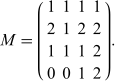 |
For example, the enlarged  consists of one
  and two
  tiles. Decorations specify the orientations needed to iterate
the rules consistently (Papadopolos and Ogievetsky 2000).
tiles. Decorations specify the orientations needed to iterate
the rules consistently (Papadopolos and Ogievetsky 2000).
The tile-count matrix  has eigenvalues
  ,
,  ,
,  , and
, and  . If
. If  is the column vector of tile
volumes in the order
is the column vector of tile
volumes in the order  ,
,  ,
,  ,
,  , then
  gives the volumes of the enlarged
tiles. Since tile inflation multiplies every edge
length by
gives the volumes of the enlarged
tiles. Since tile inflation multiplies every edge
length by  ,
it multiplies each volume by
,
it multiplies each volume by  , so
, so  . Thus
  is an eigenvector of
  with eigenvalue
  . The Dehn
invariant provides information at the linear scale
. The Dehn
invariant provides information at the linear scale  (Papadopolos and Ogievetsky 2000).
The composite-tile constructions also produce regular dodecahedra with edge lengths  for nonnegative integers
  . Smaller regular
dodecahedra occur within the enlarged structures, together with intervening composite
tiles. Unit-edge regular dodecahedra already
occur in second-order inflations, and subsequent
inflations produce nested clusters with twofold,
threefold, and fivefold symmetry (Koca et al. 2021).
. Smaller regular
dodecahedra occur within the enlarged structures, together with intervening composite
tiles. Unit-edge regular dodecahedra already
occur in second-order inflations, and subsequent
inflations produce nested clusters with twofold,
threefold, and fivefold symmetry (Koca et al. 2021).
