


A platypus graph is a nonhamiltonian graph for which deletion of any vertex produces a subgraph that is traceable.
The name alludes to the platypus being an egg-laying mammal and to the similarly hybrid nature of the graph class: every hypohamiltonian graph and every hypotraceable graph is a platypus graph, but there are platypus graphs belonging to neither class (Zamfirescu 2017).
Following Goedgebeur et al. (2020), the degenerate graph  is not counted here as a platypus graph, even though
it satisfies the literal vertex-deletion condition under the convention that
is not counted here as a platypus graph, even though
it satisfies the literal vertex-deletion condition under the convention that  is traceable.
No connected bipartite graph on at least two vertices with unequal bipartition
class sizes is platypus. If the classes have sizes  , deleting a vertex from the smaller class gives a bipartite
graph with class sizes
, deleting a vertex from the smaller class gives a bipartite
graph with class sizes  and
and  ,
whose sizes differ by at least 2. Such a graph cannot be traceable
since any Hamiltonian path in a bipartite graph
must alternate between the two bipartition classes.
,
whose sizes differ by at least 2. Such a graph cannot be traceable
since any Hamiltonian path in a bipartite graph
must alternate between the two bipartition classes.
Consequently, no complete bipartite graph is platypus: unbalanced complete bipartite graphs are ruled out by the preceding
observation, balanced  is Hamiltonian for
  , and
, and  is excluded by convention. No complete
tripartite graph is platypus (E. Weisstein, Jan. 18, 2016).
is excluded by convention. No complete
tripartite graph is platypus (E. Weisstein, Jan. 18, 2016).
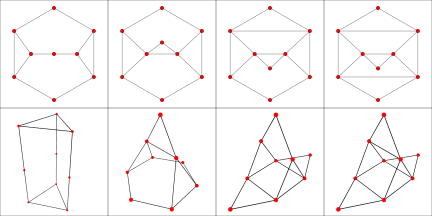
There are no platypus graphs on 8 or fewer vertices, and the numbers on  , 10, ... vertices are given by 4, 48, 814, 24847, ... (OEIS
A392591; Goedgebeur et al. 2020). The
four platypus graphs on 9 vertices (Zamfirescu 2017, Goedgebeur et al. 2020)
are illustrated above in 2- and 3-dimensional embeddings. These 4 graphs are all
line graphs that correspond to root
graphs of 4 of the 5 of the pathwidth-2 forbidden minors on 9 edges (E. Weisstein,
Jan. 17, 2025).
, 10, ... vertices are given by 4, 48, 814, 24847, ... (OEIS
A392591; Goedgebeur et al. 2020). The
four platypus graphs on 9 vertices (Zamfirescu 2017, Goedgebeur et al. 2020)
are illustrated above in 2- and 3-dimensional embeddings. These 4 graphs are all
line graphs that correspond to root
graphs of 4 of the 5 of the pathwidth-2 forbidden minors on 9 edges (E. Weisstein,
Jan. 17, 2025).
Named platypus graphs include the Barnette-Bosák-Lederberg graph, Celmins-Swart snarks, Coxeter graph, double star snark, flower snarks, Goldberg snarks, Lindgren-Sousselier graphs, Loupekine snarks, Petersen graph, Sousselier graph, 20-, 24-, and 32-Thomassen graphs, Tietze graph, and triangle-replaced Petersen graph.
There exists a cubic platypus of order  iff
iff  is even and
  , with the smallest cubic
platypus being the Petersen graph (Goedgebeur et
al. 2020).
, with the smallest cubic
platypus being the Petersen graph (Goedgebeur et
al. 2020).
There exists a cubic polyhedral platypus of order  iff
iff  is even and
  . Furthermore, all six smallest cubic
nonhamiltonian polyhedral graphs are platypuses
(Goedgebeur et al. 2020).
. Furthermore, all six smallest cubic
nonhamiltonian polyhedral graphs are platypuses
(Goedgebeur et al. 2020).
A maximally nonhamiltonian graph  is a platypus graph iff
  (Zamfirescu 2017,
Goedgebeur et al. 2020), where
(Zamfirescu 2017,
Goedgebeur et al. 2020), where  is the maximum
vertex degree and
is the maximum
vertex degree and  is the vertex count.
The smallest snark which is not a platypus has 32 vertices, and there are exactly thirteen snarks on 32 vertices that are not platypus graphs
(Goedgebeur et al. 2020). Furthermore, there exists a platypus snark
of order  iff
iff  or
or  is even and
  (Goedgebeur et al. 2020).
The  -generalized Petersen graph is platypus
iff
-generalized Petersen graph is platypus
iff  and
and  (Goedgebeur et al. 2020).
