


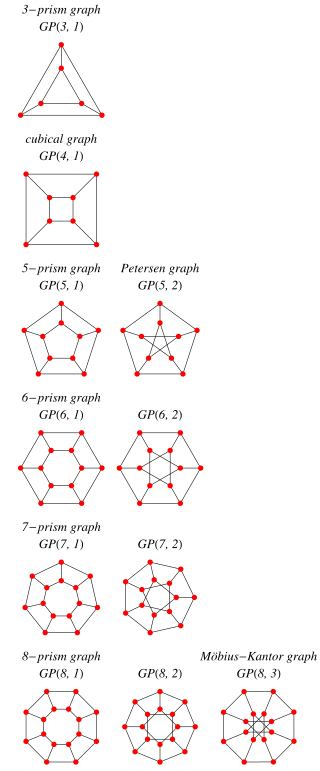
The generalized Petersen graph  , also denoted
  (Biggs 1993, p. 119; Pemmaraju and Skiena 2003,
p. 215), for
(Biggs 1993, p. 119; Pemmaraju and Skiena 2003,
p. 215), for  and
and  is a connected cubic graph consisting of an inner star
polygon
is a connected cubic graph consisting of an inner star
polygon  (circulant graph
  ) and an outer regular
polygon
) and an outer regular
polygon  (cycle graph
  ) with corresponding vertices
in the inner and outer polygons connected with edges.
These graphs were introduced by Coxeter (1950) and named
by Watkins (1969). They should not be confused with the seven Petersen
family graphs.
) with corresponding vertices
in the inner and outer polygons connected with edges.
These graphs were introduced by Coxeter (1950) and named
by Watkins (1969). They should not be confused with the seven Petersen
family graphs.
Here,  is the floor function.
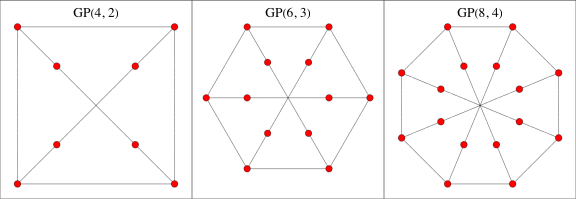
For  even, the
  -generalized Petersen graph is sometimes defined (Alspach
1983) even though, unlike usual generalized Petersen graphs, such graphs
are not cubic.
-generalized Petersen graph is sometimes defined (Alspach
1983) even though, unlike usual generalized Petersen graphs, such graphs
are not cubic.
For a cubic generalized Petersen graph,  , where
  is the edge count and
  is the vertex count. More
specifically,
is the vertex count. More
specifically,  has
has  nodes and
  edges when
  . The degenerate case
  has
has  edges.
Generalized Petersen graphs are implemented in the Wolfram Language as PetersenGraph[n,
k] and their properties are available using GraphData[ "GeneralizedPetersen",
 n,
k
n,
k
 ].
].
Generalized Petersen graphs may be further generalized to I graphs.
If  ,
then
,
then  is isomorphic to
  by interchanging the inner and outer vertices
and relabeling their indices. For example,
by interchanging the inner and outer vertices
and relabeling their indices. For example,  ,
,  ,
,  ,
,  , and so on. The numbers of nonisomorphic
generalized Petersen graphs on
, and so on. The numbers of nonisomorphic
generalized Petersen graphs on  , 8, ... nodes are 1, 1,
2, 2, 2, 3, 3, 4, 3, 5, 4, 5, 6, 6, 5, 7, ... (OEIS A077105).
, 8, ... nodes are 1, 1,
2, 2, 2, 3, 3, 4, 3, 5, 4, 5, 6, 6, 5, 7, ... (OEIS A077105).
 is vertex-transitive iff
  or
or  ,
and symmetric only for the cases
,
and symmetric only for the cases  , (5, 2), (8, 3), (10, 2), (10, 3), (12, 5), and
(24, 5) (Frucht et al. 1971; Biggs 1993, p. 119).
, (5, 2), (8, 3), (10, 2), (10, 3), (12, 5), and
(24, 5) (Frucht et al. 1971; Biggs 1993, p. 119).
No generalized Petersen graph is semisymmetric. Label its outer vertices  and inner vertices
  ,
with indices taken modulo
,
with indices taken modulo  . The map
  ,
,  is a graph
automorphism, so the adjacent vertices
is a graph
automorphism, so the adjacent vertices  and
and  lie in the same group orbit. If the graph
were edge-transitive, the orbit obstruction
for semisymmetric graphs would make it vertex-transitive. The degenerate case
lie in the same group orbit. If the graph
were edge-transitive, the orbit obstruction
for semisymmetric graphs would make it vertex-transitive. The degenerate case  is also excluded because its outer vertices have
degree three and its inner vertices
have degree two, so it is not a regular
graph.
is also excluded because its outer vertices have
degree three and its inner vertices
have degree two, so it is not a regular
graph.
Tutte proved that  has a unique 3-edge coloring.
 is the Nauru graph
  and has LCF notation
 ![[5,-9,7,-7,9,-5]^4](/images/equations/GeneralizedPetersenGraph/Inline48.svg) (Frucht 1976).
(Frucht 1976).
Known positive exact graph crossing numbers and selected candidates are summarized below. Square brackets denote candidates derived from computed upper bounds, not proved exact values.
| crossing number | generalized Petersen graph parameters |
| 1 | (6, 3), (8, 4) |
| 2 | (5, 2), (9, 3) |
| 3 | (7, 2), (9, 2), (11, 2), (13, 2), (15, 2), (17, 2), (19, 2), (27, 2) |
| 4 | (8, 3), (10, 4), (12, 3), (12, 4) |
| 5 | (11, 3), (15, 3), (15, 5) |
| 6 | [(10, 3)], (14, 3), [(18, 3)], [(18, 6)] |
| 7 | [(13, 3)], [(14, 6)], [(17, 3)] |
| 8 | [(12, 5)], [(14, 4)], [(16, 3)], [(16, 4)], [(20, 3)] |
| 9 | [(13, 5)], [(16, 7)], [(18, 8)], (19, 3), (27, 9) |
| 10 | (15, 4), (15, 6), (17, 4), (18, 4), (20, 4), (20, 9) |
| 11 | (20, 5) |
| 12 | (19, 4), (22, 4), (24, 11) |
| 14 | (20, 6) |
Wang and Zhang (2023) proved that the projective plane crossing number of  is
is  for
for  . For
. For  , they established the bounds
  .
.
All generalized Petersen graphs are unit-distance graphs (Žitnik et al. 2010). However, the only generalized Petersen
indices (some of which correspond to the same graph) which are unit-distance by twisting
correspond to  , (6, 2), (7, 2), (7, 3), (8, 2), (8, 3), (9, 2),
(9, 3), (9, 4), (10, 2), (10, 3), (11, 2), (12, 2) (Žitnik et al. 2010).
, (6, 2), (7, 2), (7, 3), (8, 2), (8, 3), (9, 2),
(9, 3), (9, 4), (10, 2), (10, 3), (11, 2), (12, 2) (Žitnik et al. 2010).
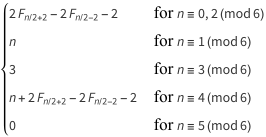
A cubic generalized Petersen graph is nonhamiltonian iff it is isomorphic to
 with
with  (Alspach 1983; Holton and Sheehan 1993, p. 316). Furthermore, the number of
Hamiltonian cycles in
(Alspach 1983; Holton and Sheehan 1993, p. 316). Furthermore, the number of
Hamiltonian cycles in  for
for  is given by
 |
(1)
|
(Schwenk 1989; Holton and Sheehan 1993, p. 316).
The following table gives some special cases of the generalized Petersen graph.
| graph | generalized Petersen graph |
cubic symmetric graph  |  |
| cubical graph |  |
| Desargues graph |  |
| dodecahedral graph |  |
| Dürer graph |  |
| Möbius-Kantor graph |  |
| Nauru graph |  |
| Petersen graph |  |
| prism graph |  |
Krishnan et al. (2026) determined the remaining zero forcing number values for two subfamilies:  for every
  and
and  for every
  . The smaller values of
  for
for  , 8, ..., 12 are 6, 6, 6, 8, 7, 7, and those of
  for
for  , 10, ..., 17 are 6, 6, 7, 6, 8, 8, 9, 8, 9. Krishnan et
al. (2026) report AI assistance with mathematical exploration, programming, and
formalization.
, 10, ..., 17 are 6, 6, 7, 6, 8, 8, 9, 8, 9. Krishnan et
al. (2026) report AI assistance with mathematical exploration, programming, and
formalization.

 and
and  ." 16 Oct 2026.
  in the Projective Plane." AKCE Int. J. Graphs
Combin. 20, 332-338, 2023.
in the Projective Plane." AKCE Int. J. Graphs
Combin. 20, 332-338, 2023.