


A maximally nonhamiltonian graph is a nonhamiltonian graph  for which
  is Hamiltonian for each edge
  in the graph complement
of
in the graph complement
of  ,
i.e., every two nonadjacent vertices are endpoints of a Hamiltonian
path.
,
i.e., every two nonadjacent vertices are endpoints of a Hamiltonian
path.
Since an edge added between two disconnected components of a disconnected graphs is a bridge, and after crossing a bridge in one direction, a Hamiltonian cycle cannot "cross back" in the other, it can be seen that only connected nonhamiltonian graphs can be maximally nonhamiltonian.
The status of the path graph  is debatable since it is nonhamiltonian but has empty graph
complement, but by a strict interpretation that "all 0 of its complement's edges
result in a Hamiltonian graph," it should be considered maximally nonhamiltonian.
is debatable since it is nonhamiltonian but has empty graph
complement, but by a strict interpretation that "all 0 of its complement's edges
result in a Hamiltonian graph," it should be considered maximally nonhamiltonian.
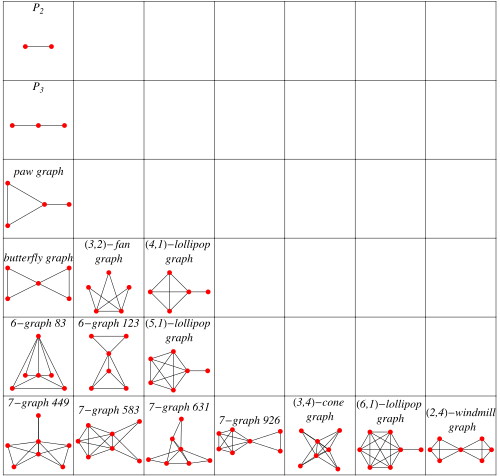
The numbers of maximally nonhamiltonian graphs on  , 2, ... vertices are 0, 1, 1, 1, 3, 3, 7, 9, 18, 31, ...
(OEIS A185306), the first few of which are
illustrated above. Larger examples the Coxeter graph,
flower snarks
, 2, ... vertices are 0, 1, 1, 1, 3, 3, 7, 9, 18, 31, ...
(OEIS A185306), the first few of which are
illustrated above. Larger examples the Coxeter graph,
flower snarks  for odd
  , Petersen graph, and
Tietze graph (Clark and Entringer 1983).
, Petersen graph, and
Tietze graph (Clark and Entringer 1983).
A maximally nonhamiltonian graph  is a platypus graph iff
  (Zamfirescu 2017, Goedgebeur et al. 2020), where
  is the maximum
vertex degree and
is the maximum
vertex degree and  is the vertex count.
