


A polyhedral graph (sometimes called a  -net) is a 3-connected simple planar graph.
An
 -polyhedral
graph has
 vertices. Every convex
polyhedron can be represented in the plane or on the
surface of a sphere by a 3-connected planar graph. Conversely, by a theorem of Steinitz as
restated by Grünbaum (2003, p. 235), every 3-connected planar graph can be realized as a convex
polyhedron (Duijvestijn and Federico 1981). Polyhedral graphs are sometimes simply
known as "polyhedra" (which is rather confusing since the term "polyhedron"
more commonly refers to a solid with
 faces, not
 vertices).
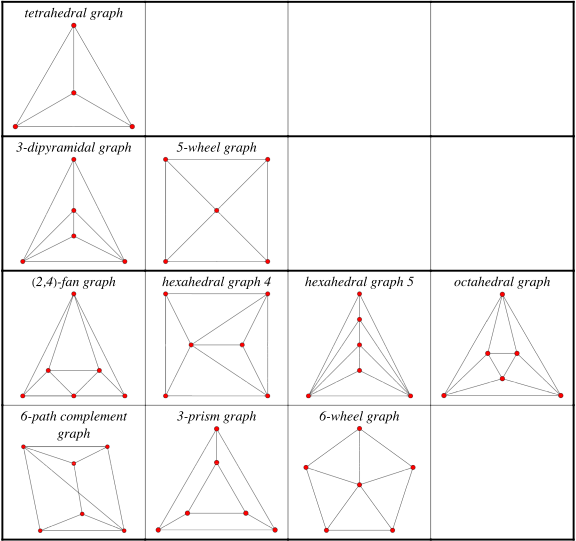
The numbers of distinct polyhedral graphs having  , 2, ... vertices are 0,
0, 0, 1, 2, 7, 34, 257, 2606, ... (OEIS A000944;
Duijvestijn and Federico 1981; Croft et al. 1991; Dillencourt 1992; Grünbaum
2003, p. 424). Through duality, each polyhedral
graph on
 nodes corresponds to a graph
(and polyhedron) with
 faces. This gives a bijection
between isomorphism classes. A graph
need not be isomorphic to its dual
graph. For example, the cubical graph has eight
vertices and six faces,
while its dual graph, the octahedral
graph, has six vertices and eight faces.
The names pentahedral, hexahedral, heptahedral, octahedral, nonahedral, and decahedral graph have been used for the vertex count classes from five through ten (Gayathri 2018, pp. 50-51). Explicit vertex count names distinguish these classes from the skeletons of polyhedra named by their numbers of faces and from the Platonic graphs.
There is no known formula for enumerating the number of nonisomorphic polyhedral graphs by numbers of edges  , vertices
 , or faces
 (Harary and Palmer 1973, p. 224; Duijvestijn and Federico
1981). The numbers for the first few are summarized in the table below.

Duijvestijn and Federico (1981) enumerated the polyhedral graphs on  edges, obtaining 1, 0, 1, 2, 2, 4, 12, 22, 58, 158, 448, ...
(OEIS A002840) for
 , 7, 8, ....
The smallest nonhamiltonian polyhedral graphs have 11 vertices. One example is the Herschel
graph. The numbers of nonhamiltonian
polyhedral graphs on  ,
12, ... vertices are 74, 1600, 43984, 1032208, 22960220,
... (OEIS A007033). The numbers of nonhamiltonian maximal planar graphs, corresponding to simplicial
polyhedra, on
 , 12, ... vertices are 1,
2, 30, 239, 2369, 22039, 205663, ... (OEIS A007030;
Dillencourt 1992). The unique 11-vertex example in
this subclass is the Goldner-Harary graph.
The numbers of nonhamiltonian polyhedral
graphs with
 ,
10, ... faces are 1, 8, 135, 2557, ... (OEIS A007032;
Dillencourt 1992).
There are no untraceable polyhedral graphs on 13 or fewer vertices.
As shown by Whitney (1932), polyhedral graphs are uniquely embeddable (Fleischner 1973).

 -Nets of Orders 8 to 19, Inclusive, 2 vols. Unpublished
manuscript. Eindhoven, Netherlands: Philips Research Laboratories, 1960.Britton,
D. and Dunitz, J. D. "A Complete Catalogue of Polyhedra with Eight or Fewer
Vertices." Acta Cryst. A 29, 362-371, 1973.