


A uniquely embeddable graph is a planar graph whose embeddings on the sphere are all equivalent under a homeomorphism of the sphere sending one drawing to the other. The vertices are not fixed labels, so such a homeomorphism may induce a graph automorphism.
Every uniquely embeddable graph has a dual graph unique up to isomorphism, but this condition alone is not sufficient for unique embeddability.
Whitney (1932) proved that polyhedral graphs are uniquely embeddable.
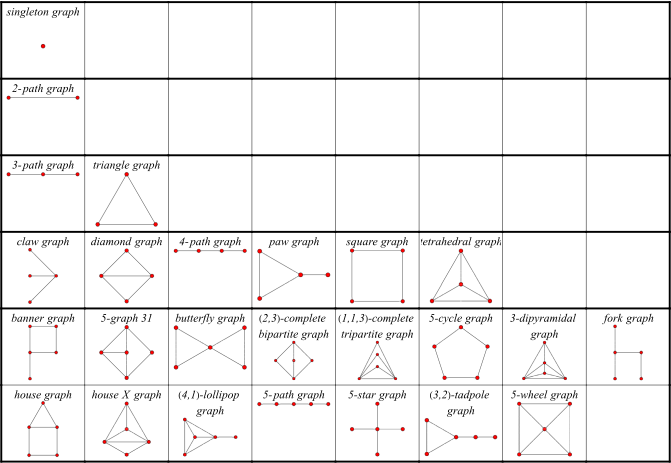
The numbers of uniquely embeddable connected graphs on  ,
2, ... vertices are 1, 1, 2, 6, 15, 51, 206, 1297,
11742, 143095, 2056120, 32337106, ... (OEIS A372853),
the first few of which are illustrated above. The largest numbers of planar
embeddings for connected planar
graphs on
 ,
2, ... vertices are 1, 1, 1, 1, 2, 6, 24, 80, 240,
1080, 3780, 13440, ... (OEIS A372854).
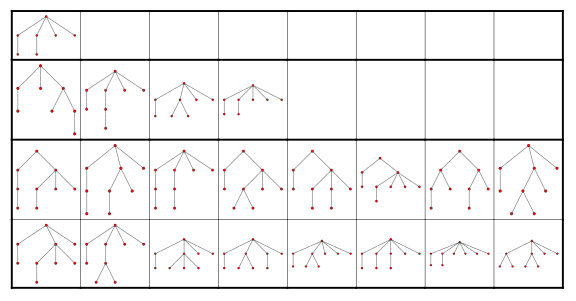
Because some trees have branches that cannot be interchanged homeomorphically around a common fork, not all trees are
uniquely embeddable. The smallest not uniquely embeddable tree
has 7 vertices, and there is exactly
one such tree. It is not uniquely embeddable because
the two short branches can be either adjacent or between the two long branches, giving
two distinct planar embeddings. There are
four 8-vertex trees that
are not uniquely embeddable, including the 4-centipede
graph. The numbers of not uniquely embeddable trees
on  ,
2, ... vertices are 0, 0, 0, 0, 0, 0, 1, 4, 16, 49,
140, 390, ... (OEIS A378673), with the corresponding
number of uniquely embeddable trees given by 1, 1, 1, 2,
3, 6, 10, 19, 31, 57, 95, 161, ... (OEIS A378672).
Fleischner (1973) used a stronger notion of equivalence for labeled graphs, distinct from the sphere homeomorphism
convention above. The following characterization is for that stronger notion: a connected planar graph  is uniquely embeddable in the plane iff
 is one of the following graphs:
1.  is homeomorphic to a 3-connected
graph,
2.  is homeomorphic to the complete
bipartite graph
 ,
3.  is homeomorphic to the triangle
graph
 ,
4.  is homeomorphic to
 or
 ,
5.  is homeomorphic to
 , or
6.  is homeomorphic to
 with
 and
 .
