

A planar map is a cellular embedding of a finite connected graph in the sphere, considered up to orientation-preserving homeomorphism, with graph loops and multiple edges allowed. This convention, commonly used when counting maps, treats mirror images as distinct unless they are explicitly identified (Erickson 2017).
A planar map records the incidences and cyclic orderings of vertices, edges, and faces. A planar map therefore contains more information than the underlying planar graph, but does not specify graph vertex coordinates or the shapes of edges.
A graph face is a region complementary to the embedded graph. Because the embedding is cellular, every graph face
is homeomorphic to an open disk.
The boundary of a graph face need not be a graph
cycle, since the boundary may visit a graph vertex
repeatedly and traverses each graph bridge twice.
If  counts graph
edge occurrences on the boundary of a graph face
counts graph
edge occurrences on the boundary of a graph face  , then
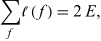 |
where  is the edge
count. The vertex count
is the edge
count. The vertex count  and graph face count
  also satisfy
 |
Choosing a graph face to be unbounded gives a corresponding planar graph embedding. Under conventions
that define planar maps directly in the plane, this choice
of outer graph face is part of the data. A rotation
system encodes the cyclic orders of incident
edges and determines a cellular embedding of the connected graph. The resulting surface
is a sphere iff  (Erickson 2020).
A planar map is distinct from a map graph, which records adjacency of regions, and from a map meaning a function. The dual graph of a planar map may have graph loops or multiple edges even when its underlying graph is a simple graph.
