


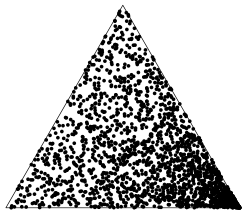
Triangle point picking is the uniform selection by area of a random point inside a nondegenerate triangle.
Given a triangle with one vertex
at the origin and the others at positions  and
 , one might think that a random point
inside the triangle would be given by
 |
(1)
|
where  and
 are independent uniform variates in the interval
 . This samples the triangle
nonuniformly, concentrating points in the
 corner.
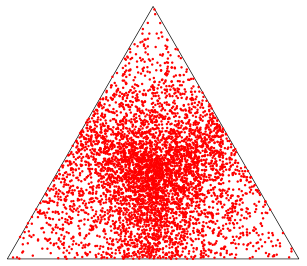
Picking three independent uniform variates in  as proportional trilinear coordinates also
does not produce uniform point spacing in the triangle.
The resulting area density is greatest at the incenter.
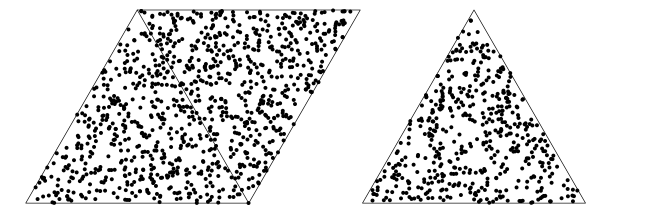
To pick points uniformly distributed inside the triangle, instead pick
 |
(2)
|
where  and
 are independent uniform variates in the interval
 , which gives points
uniformly distributed in the parallelogram spanned
by
 and
 (left figure). Keep the points with
 . The remaining points
can either be discarded or transformed by
 into the triangle
interior (right figure).
The expected distance of a point picked at random inside an equilateral triangle of unit side length from the center of the triangle is
 |
(3)
|
and the expected distance from a fixed vertex is
 |
(4)
|
The expected distance from the closest vertex is
 |
(5)
|
while the expected distance from the farthest is
 |
(6)
|
Picking  points independently and uniformly from a triangle
with unit area gives a convex
hull with expected area of
 |  |  |
(7)
|
 |  |  |
(8)
|
where  is an integer and
 is a harmonic number
(Buchta 1984, 1986). The first few values are 0, 0, 1/12, 1/6, 43/180, 3/10, 197/560,
... (OEIS A093762 and A002548),
with
 .
This is a special case of simplex simplex picking.
