


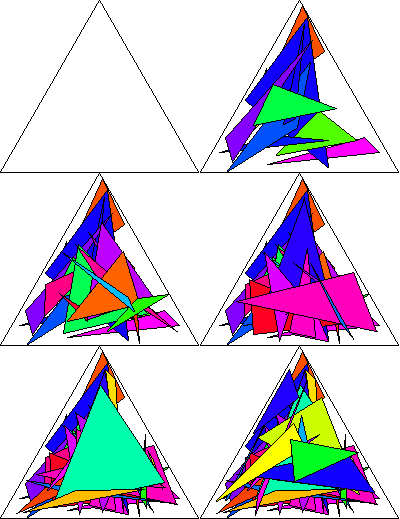
Triangle triangle picking is the selection of three independent points, each uniformly distributed over the interior of a triangle of positive area. Let
 denote the area of the triangle
formed by the selected points divided by the area
of the original triangle. The problem of finding the
mean triangle area when the original triangle
has unit area was proposed by Watson (1865) and solved by
Sylvester. Its solution is a special case of the general formula for polygon
triangle picking.
Since the problem is affine, it can be solved by considering for simplicity an isosceles right triangle
with unit leg lengths and area  . Integrating the formula for the area
of a triangle over the six coordinates of the vertices,
dividing by the integral of unity over the region,
and dividing by the original triangle's area
gives
 |  |  |
(1)
|
 |  |  |
(2)
|
where
 |
(3)
|
is the signed triangle area of a triangle with vertices  ,
 , and
 .
The integral can be solved using computer algebra by breaking up the integration region using cylindrical algebraic decomposition. This results in 62 regions, 30 of which have distinct integrals, each of which can be directly integrated. Combining the results then gives the result
 |
(4)
|
(Pfiefer 1989, Zinani 2003).
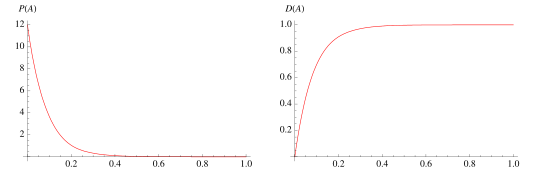
The exact distribution function  of
 was derived by Philip (n.d., p. 10). Its probability
density function
 and
 are given by
 |
(5)
|
where the subscript 1 denotes  and 2 denotes
 . Values at
 and
 are obtained by continuous limits. Outside the unit interval,
 ,
while
 for
 and
 for
 .
The raw moments  of
 for
 , 2, ... are 1/12, 1/72, 31/9000, 1/900, 1063/2469600, 403/2116800,
... (OEIS A103474 and A103475).
The central moments  of
 for
 , 2, ... are 0, 1/144, 61/54000, 343/864000, 9493/66679200,
... (OEIS A130117 and A130118).
