


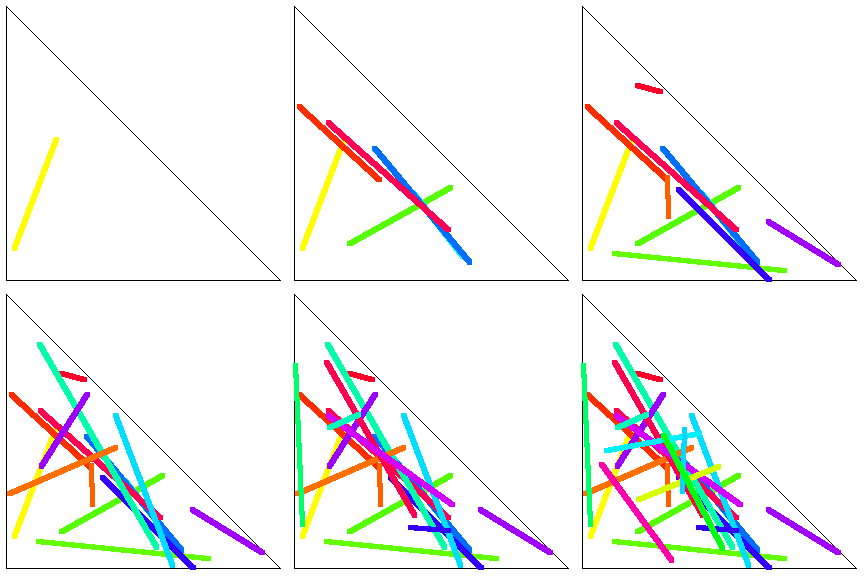
Triangle line picking is the selection of the line segment joining two independent points chosen uniformly by area
in a nondegenerate triangle. For a triangle  , the side lengths
  ,
,  , and
, and  are positive and satisfy the strict triangle
inequality. This problem is not affine, but a simple
formula in terms of the area or linear properties of the
original triangle can be found using Borel's overlap technique to collapse the quadruple
integral to a double integral and then convert to polar
coordinates, leading to the beautiful general formula
are positive and satisfy the strict triangle
inequality. This problem is not affine, but a simple
formula in terms of the area or linear properties of the
original triangle can be found using Borel's overlap technique to collapse the quadruple
integral to a double integral and then convert to polar
coordinates, leading to the beautiful general formula
 |  | ![(4ss_as_bs_c)/(15)[1/(a^3)ln(s/(s_a))+1/(b^3)ln(s/(s_b))+1/(c^3)ln(s/(s_c))]](/images/equations/TriangleLinePicking/Inline7.svg) |  |  |
(1)
|
(A. G. Murray, pers. comm., Apr. 4, 2020), where  is the semiperimeter
and
is the semiperimeter
and  ,
,
 ,
and
,
and 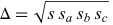 .
The formulas for odd moments have a similar form to that of the mean but with higher
powers of
.
The formulas for odd moments have a similar form to that of the mean but with higher
powers of  ,
,
 ,
,
 ,
and the triangle area
,
and the triangle area  .
.
This formula immediately gives the following special cases.
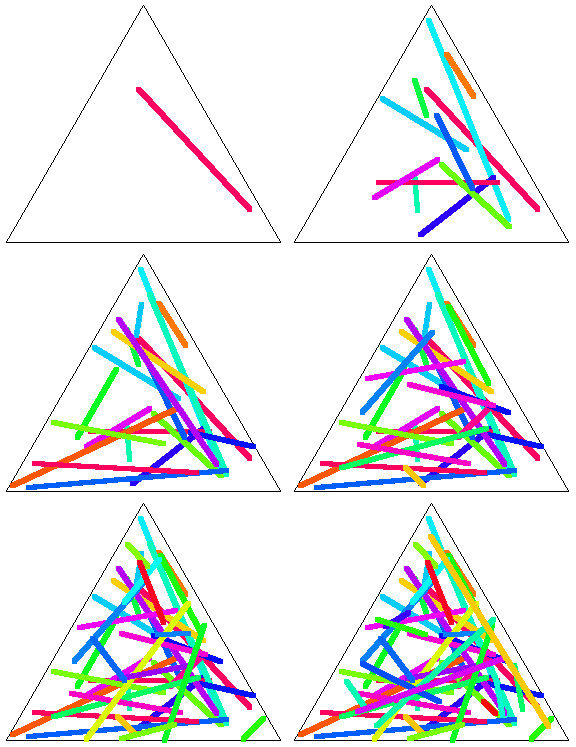
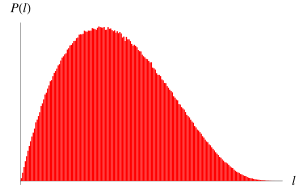
If the original triangle is chosen to be an equilateral triangle with unit side lengths, then the mean length of the line segment joining two independent points chosen uniformly inside it is given by
 |  |  |
(2)
|
 |  |  |
(3)
|

The integrand can be split up into the four pieces
 |  |  |
(4)
|
 |  |  |
(5)
|
 |  |  |
(6)
|
 |  |  |
(7)
|
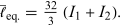
As illustrated above, symmetry immediately gives  and
and  , so
, so
 |
(8)
|
With some effort, the integrals  and
and  can be done analytically to give the final beautiful result
 |  |  |
(9)
|
 |  |  |
(10)
|
(OEIS A093064; E. W. Weisstein, Mar. 16, 2004).

If the original triangle is chosen to be an isosceles right triangle with unit legs, then the mean length of the line segment joining two independent points chosen uniformly inside it is given by
 |  |  |
(11)
|
 |  | ![1/(30)[2+4sqrt(2)+(4+sqrt(2))sinh^(-1)1]](/images/equations/TriangleLinePicking/Inline51.svg) |
(12)
|
 |  |  |
(13)
|
 |  |  |
(14)
|
(OEIS A093063; M. Trott, pers. comm., Mar. 10, 2004), which is numerically surprisingly close to  .
.
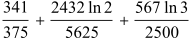
The mean length of a line segment picked at random in a 3, 4, 5 triangle is given by
 |  |  |
(15)
|
 |  |  |
(16)
|
 |  |  |
(17)
|
(E. W. Weisstein, Aug. 6-9, 2010; OEIS A180307).
The mean length of a line segment picked at random in a 30-60-90 triangle with unit hypotenuse was computed by E. W. Weisstein (Aug. 5, 2010) as a complicated analytic expression involving sums of logarithms. After simplification, the result can be written as
 |  |  |
(18)
|
 |  |  |
(19)
|
(E. Weisstein, M. Trott, A. Strzebonski, pers. comm., Aug. 25, 2010; OEIS A180308).
The expected distance from a random point in a general triangle to the vertex  opposite the side of length
  is
is
 |
(20)
|
(A. G. Murray, pers. comm., Apr. 4, 2020), with analogous expressions for  and
and  .
These give the beautiful identity
.
These give the beautiful identity
![l^__(Delta(a,b,c))=1/5[d_(Delta(a,b,c),A)+d_(Delta(a,b,c),B)+d_(Delta(a,b,c),C)].](/images/equations/TriangleLinePicking/NumberedEquation3.svg) |
(21)
|
(A. G. Murray, pers. comm., Apr. 4, 2020).
