


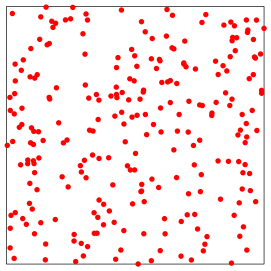
Square point picking generates points uniformly distributed over the unit square by independently selecting values  and
 from a uniform distribution
on
 and placing them at coordinates
 .
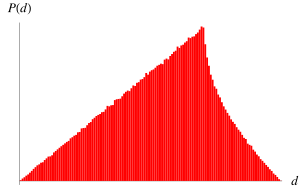
The distribution of distances  from a randomly selected point in the unit
square to its center is illustrated above.
The expected distance to the square's center is
 |  |  |
(1)
|
 |  |  |
(2)
|
 |  |  |
(3)
|
 |  |  |
(4)
|
(Finch 2003, p. 479; OEIS A103712), where  is the universal parabolic constant.
The expected distance to a fixed vertex is given by
 |  |  |
(5)
|
 |  |  |
(6)
|
which is exactly twice  .
The expected distances from the closest and farthest vertices are given by
 |  |  |
(7)
|
 |  |  |
(8)
|
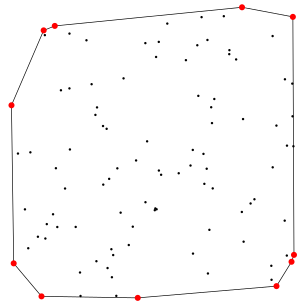
For an integer  , pick
 points independently and uniformly in a unit
square and take the convex hull
 . Let
 be the expected area of
 ,
 the expected perimeter,
and
 the expected number of vertices of
 . Then
 |  |  |
(9)
|
 |  |  |
(10)
|
 |  |  |
(11)
|
 |  |  |
(12)
|
 |  |  |
(13)
|
 |  |  |
(14)
|
(OEIS A096428 and A096429), where  is the multiplicative inverse of Gauss's constant,
 is the gamma function, and
 is the Euler-Mascheroni
constant (Rényi and Sulanke 1963, 1964; Finch 2003, pp. 480-481).
The variance of the perimeter satisfies
 |  |  |
(15)
|
 |  |  |
(16)
|
where
 |  |  |
(17)
|
 |  |  |
(18)
|
 |  |  |
(19)
|
and
 |  |  |
(20)
|
 |  |  |
(21)
|
(Groeneboom 1988; Cabo and Groeneboom 1994, pp. 39 and 43; Keane 2000; Finch 2003, p. 481).

 zufällig gewählten Punkten, I." Z. Wahrscheinlichkeits 2,
75-84, 1963.Rényi, A. and Sulanke, R. "Über die konvexe
Hülle von
 zufällig gewählten Punkten, II." Z. Wahrscheinlichkeits 3,
138-147, 1964.Sloane, N. J. A. Sequences