


A transmission-minimal regular graph is a connected  -regular simple graph
 on
 vertices whose graph
transmission
 is minimum among all connected
 -regular simple graphs
on
 vertices. Equivalently, for fixed
 and
 , such a graph minimizes the Wiener
index and the mean distance.
The term is introduced here for this extremal class of graphs. Such graphs might also be described as extremal average-distance regular graphs or optimal average-distance regular graphs. A transmission-minimal regular graph should not be confused with a transmission-regular graph, which is a graph whose vertices all have the same vertex transmission. The word "regular" in transmission-minimal regular graph refers to vertex degree, not vertex transmission.
The same problem is posed for  -regular graphs by Knor et
al. (2019). Knor et al. (2016) conjectured that, among all
 -regular graphs on
 vertices, the minimum Wiener
index is attained by a graph with the minimum possible
diameter. Closely related computational problems
arise in the order/degree problem and the Graph Golf competition, where fixed-degree
graphs with small diameter
and average shortest path length are sought (Kitasuka
et al. 2018, Graph Golf 2021). Transmission-minimal regular graphs often have
other extremal properties (Rokicki, pers. comm., May 11, 2026). In fact, many such
graphs are among the smallest
cubic crossing number graphs and smallest
quartic crossing number graphs.
Counts of small transmission-minimal cubic graphs, up to graph isomorphism, are summarized in the following table. The rows for 6 through 22 vertices are given by Knor et al. (2019, p. 128). The examples column lists named representatives where available and elides additional unnamed graphs. The counts (OEIS A395987) and minimum graph transmissions (OEIS A395986) are indexed by half the number of vertices.
| vertices | count | minimum transmission | examples |
| 4 | 1 | 6 | tetrahedral
graph  |
| 6 | 2 | 21 | utility graph  ,
3-prism graph |
| 8 | 2 | 44 | Wagner
graph  and one other |
| 10 | 1 | 75 | Petersen
graph  |
| 12 | 2 | 126 | twinplex graph, triplex graph |
| 14 | 7 | 189 | Heawood
graph, generalized Petersen graph  ,
box graph, and 4 others |
| 16 | 6 | 264 | 6 graphs |
| 18 | 1 | 351 | 1 graph |
| 20 | 1 | 450 | 1 graph |
| 22 | 1 | 573 | 1 graph |
| 24 | 1 | 708 | McGee graph |
| 26 | 2 | 871 | CNG
9A, generalized Petersen graph  |
For the displayed cubic rows with  vertices, the
minimum graph transmissions are given by
 |
(1)
|
Indeed, in a cubic graph on  vertices, each graph
vertex has three vertices at distance
1 and at most six at distance 2, so
 for every graph vertex
 and hence
 |
(2)
|
Equality holds exactly when, for every graph vertex  ,
there are six vertices at distance
2 from
 and all remaining
 vertices are at distance
exactly 3. Equivalently, every graph vertex has distance distribution
 |
(3)
|
The displayed  ,
 , and
 rows are exceptional, with minimum graph
transmissions
 ,
 , and
 , respectively (Knor et al. 2019; E. Weisstein,
May 12-13 and 20, 2026).
Corresponding counts of small transmission-minimal quartic graphs, up to graph isomorphism, are given below. The rows for 6 through 17 vertices are given by Knor et al. (2019, p. 129). The counts (OEIS A395989) and minimum graph transmissions (OEIS A395988) are indexed by the number of vertices.
| vertices | count | minimum transmission | examples |
| 5 | 1 | 10 | pentatope
graph  |
| 6 | 1 | 18 | octahedral
graph  |
| 7 | 2 | 28 | circulant
graph  and one other |
| 8 | 6 | 40 | complete
bipartite graph  , rook graph  , antiprism graph  ,
and 3 others |
| 9 | 16 | 54 | circulant graphs  and  ,
generalized quadrangle  , and 13 others |
| 10 | 24 | 70 | circulant
graph  and 23 others |
| 11 | 37 | 88 | Andrásfai graph and 36 others |
| 12 | 26 | 108 | circulant graph  ,
Chvátal graph, quartic
vertex-transitive graph Qt17, and 23 others |
| 13 | 10 | 130 | 13-cyclotomic graph and 9 others |
| 14 | 1 | 154 | 1 graph |
| 15 | 1 | 180 | 1 graph |
| 16 | 1 | 210 | 1 graph |
| 17 | 2 | 247 | 2 graphs |
| 18 | 1 | 283 | 1 graph |
For a connected quartic graph  on
 vertices, counting its
four neighbors and
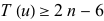 non-neighbors gives
 for every graph vertex
 ,
and so
 |
(4)
|
Equality holds exactly when every graph vertex has all remaining  non-neighbors at distance
2, i.e., when
 has diameter at most 2.
This gives the quartic table values for
 . The rows
 ,
 , and
 are exceptional; exhaustive enumeration gives the minimum
graph transmissions
 ,
 , and
 , respectively (Knor et al. 2019; E. Weisstein,
May 12-13, 2026).
