


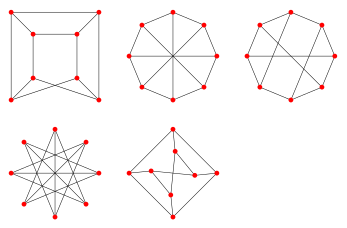
The Wagner graph is a name sometimes given to the 4-Möbius ladder (Bondy and Murty 2008, pp. 275-276). The association arises through
the theorem of Wagner (1937) that graphs having no  minor
can be constructed using clique-sum operations to combine planar
graphs and this graph. It is illustrated above in a
number of drawings.
minor
can be constructed using clique-sum operations to combine planar
graphs and this graph. It is illustrated above in a
number of drawings.
The Wagner graph has the most spanning trees among the six 8-vertex cubic graphs, namely 392.
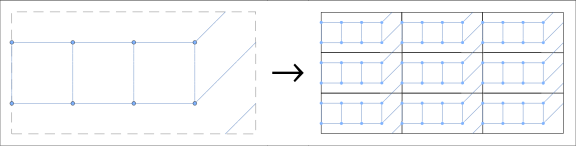
It is a toroidal graph, as illustrated above. The left-hand drawing shows an embedding in a fundamental region whose paired boundary sides are identified to form a torus. The right-hand drawing shows a finite patch of the corresponding periodic lift, illustrating how edges continue across these boundaries and where corresponding vertices in different regions represent the same vertex on the torus.
The Wagner graph is implemented in the Wolfram Language as GraphData["WagnerGraph"].

 ."
."