


A tetrahedral mesh is a three-dimensional mesh whose maximal cells are tetrahedra. In a conforming tetrahedral mesh, two tetrahedra meet, if at all, in a complete common face, polyhedron edge, or polyhedron vertex.
Tetrahedral meshes discretize three-dimensional domains for the finite element method. Their quality is controlled by geometric conditions such as ratios of characteristic lengths and dihedral angles, and they are commonly constructed by mesh generation algorithms based on Delaunay triangulation.
Bern et al. (1995) gave an angle-based classification of tetrahedra into six types according to their small and large solid angles and dihedral angles. Cheng et al. (1999, p. 3) distinguished this from their classification based primarily on the angles within the faces, which gives the nine nearly degenerate types illustrated below.
For meshes intended to have comparable resolution in all directions, well-proportioned tetrahedra are often preferred to nearly degenerate ones. The following tables illustrate two well-shaped examples and a classification of skinny and nearly flat examples (Cheng et al. 2012, pp. 24-25; Hannukainen et al. 2017, p. 3). Here "round" describes a well-proportioned example rather than a separate mathematical class. The skinny and nearly flat classifications are qualitative; their names do not prescribe numerical mesh quality values.
The first table shows well-shaped examples.
| representative | shape | geometric feature |
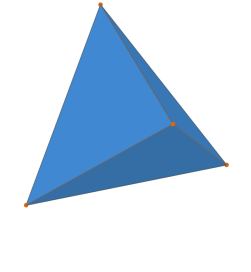
| regular tetrahedron | six equal edges |
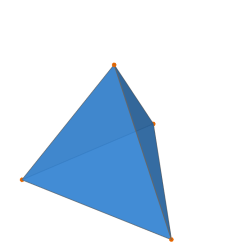
| round (well-shaped) | comparable dimensions; not necessarily regular |
The skinny examples approach a line. The names spire and needle are synonyms in this classification.
| representative | shape | geometric feature |

| spire (needle) | three vertices near one endpoint |
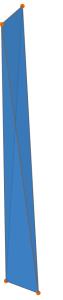
| splinter | two separated close vertex pairs |

| spindle | four distinct positions along a line |

| spear | close vertex pair near the middle |

| spike | close vertex pair near an endpoint |
The nearly flat examples approach a plane.
| representative | shape | geometric feature |

| wedge | two vertices close together |

| spade | one vertex near an opposite edge |

| cap | one vertex near the opposite face interior |

| sliver | four almost coplanar vertices with quadrilateral projection |
Mesh quality depends on the application. Some directionally stretched elements, including spires with suitable dihedral angles, can be useful. Comparable edge lengths alone do not exclude a sliver (Cheng et al. 2012, pp. 25-26).
These shape distinctions can guide mesh quality improvement. For example, the method of Gao et al. (2012) handles spade, cap, and sliver tetrahedra by inserting one or two additional vertices before repositioning vertices to improve the resulting elements.

 -Simplices." Appl. Math. 62,
1-13, 2017.