


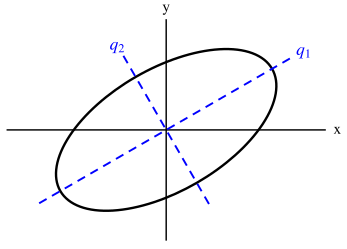
A principal axis of a real symmetric matrix  is a line through
the origin spanned by an eigenvector
of
is a line through
the origin spanned by an eigenvector
of  . By the spectral
theorem, there is an orthogonal matrix
. By the spectral
theorem, there is an orthogonal matrix  whose columns form an orthonormal
basis of such eigenvectors and for which
whose columns form an orthonormal
basis of such eigenvectors and for which
 |
where the  are the eigenvalues of
  . When an eigenvalue is repeated,
the choice of principal axes within its eigenspace
need not be unique.
. When an eigenvalue is repeated,
the choice of principal axes within its eigenspace
need not be unique.
For a quadratic form  , the principal axes are the coordinate directions in which
the quadratic form is represented by a diagonal
matrix, so it contains only squared coordinate terms. For the symmetric matrix
representing moment of inertia, these directions
make the matrix diagonal, with diagonal entries equal to the moments of inertia about
the corresponding axes. The principal axes of a covariance
matrix give the directions used in principal
component analysis.
, the principal axes are the coordinate directions in which
the quadratic form is represented by a diagonal
matrix, so it contains only squared coordinate terms. For the symmetric matrix
representing moment of inertia, these directions
make the matrix diagonal, with diagonal entries equal to the moments of inertia about
the corresponding axes. The principal axes of a covariance
matrix give the directions used in principal
component analysis.
In geometry, the axis about which a surface of revolution is generated is also called a principal axis. In particular, the central axes of symmetry of a right circular cylinder and a right circular cone are their principal axes. A sphere has no uniquely distinguished principal axis, since every line through its center is an axis of symmetry.
