

A symmetric matrix is a square matrix that satisfies
 |
(1)
|
where  denotes the transpose, so
  . This also implies
 |
(2)
|
where  is the identity matrix. For example,
![A=[4 1; 1 -2]](/images/equations/SymmetricMatrix/NumberedEquation3.svg) |
(3)
|
is a symmetric matrix. Hermitian matrices are a useful generalization of symmetric matrices for complex matrices.
A matrix that is not symmetric is said to be an asymmetric matrix, not to be confused with an antisymmetric matrix.
A matrix  can be tested to see if it is symmetric in the Wolfram
Language using SymmetricMatrixQ[m].
can be tested to see if it is symmetric in the Wolfram
Language using SymmetricMatrixQ[m].
Written explicitly, the elements of a symmetric matrix  have the form
![[a_(11) a_(12) ... a_(1n); a_(12) a_(22) ... a_(2n); | | ... |; a_(1n) a_(2n) ... a_(nn)].](/images/equations/SymmetricMatrix/NumberedEquation4.svg) |
(4)
|
The symmetric part of any matrix may be obtained from
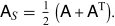 |
(5)
|
A matrix  is symmetric if it can be expressed in the form
 |
(6)
|
where  is an orthogonal matrix and
  is a diagonal matrix. This
is equivalent to the matrix equation
is a diagonal matrix. This
is equivalent to the matrix equation
 |
(7)
|
which is equivalent to
 |
(8)
|
for all  ,
where
,
where  .
Therefore, the diagonal elements of
.
Therefore, the diagonal elements of  are the eigenvalues of
  , and the columns of
  are the corresponding eigenvectors.
The numbers of symmetric matrices of order  on
on  symbols are
  ,
,  ,
,  ,
,  , ...,
  . Therefore, for (0,1)-matrices,
the numbers of distinct symmetric matrices of orders
. Therefore, for (0,1)-matrices,
the numbers of distinct symmetric matrices of orders  , 2, ... are 2, 8, 64, 1024, ... (OEIS A006125).
