


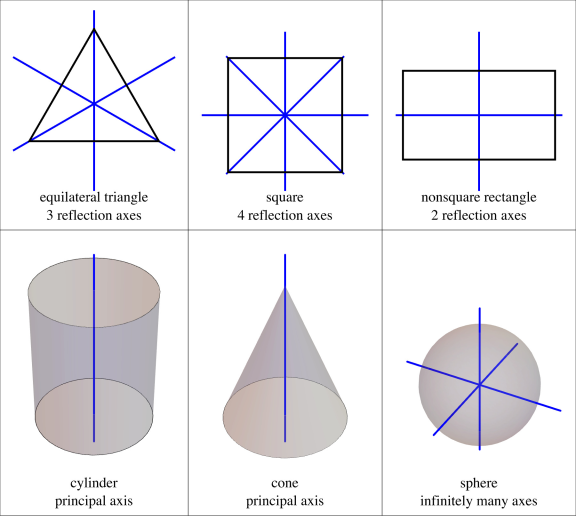
An axis of symmetry is a line about which a geometric object has a nontrivial reflection or rotational symmetry. Here nontrivial means that the symmetry maps the object onto itself but is not the identity map. At least one point of the object is moved. For a plane figure, this normally means that reflection in the line maps the figure onto itself. Points on the line remain fixed, while points away from it are interchanged with their mirror images. The number of axes of symmetry can be any nonnegative integer, or it can be infinite.
For example, the parabola  , where
  , has axis of symmetry
 |
An equilateral triangle has three axes of symmetry, a square has four, and a nonsquare rectangle has two, as illustrated above. A circle has infinitely many axes of symmetry, since every line through its center is an axis of symmetry.
For a geometric object in three-dimensional space, such as a surface or solid, the term commonly denotes an axis of rotational symmetry. The principal axis of a right circular cylinder is the line through the centers of its circular bases. The line through the apex and center of the circular base of a right circular cone is likewise its principal axis. These are axes of continuous rotational symmetry, and each object is unchanged by every rotation about its indicated axis. A sphere has infinitely many rotational axes of symmetry, since every line through its center can serve as such an axis. An axis of rotational symmetry is a line, whereas a plane of symmetry is fixed by a reflection.
