


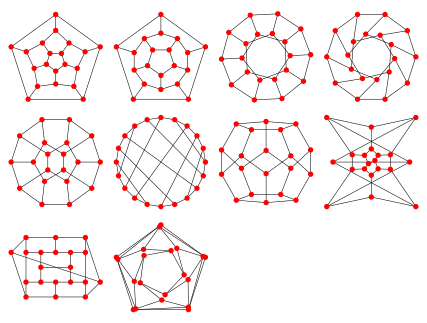
The dodecahedral graph is the Platonic graph corresponding to the connectivity of the vertices of a dodecahedron, illustrated above in four drawings. The left drawing shows a stereographic projection of the dodecahedron, the second an orthographic projection, the third is from Read and Wilson (1998, p. 162), and the fourth is derived from LCF notation.
The dodecahedral graph is the skeleton of the great stellated dodecahedron as well as the dodecahedron.
It is the cubic symmetric graph denoted  and is isomorphic to the generalized
Petersen graph
and is isomorphic to the generalized
Petersen graph  .
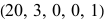
It can be described in LCF notation as [10, 7, 4,
.
It can be described in LCF notation as [10, 7, 4,
 ,
,
 ,
10,
,
10,  ,
7,
,
7,  ,
,
![4]^2](/images/equations/DodecahedralGraph/Inline7.svg) .
.
The dodecahedral graph is implemented in the Wolfram Language as GraphData["DodecahedralGraph"].
It is distance-regular with intersection array  and is also distance-transitive. It
is also its own distance-4 graph distance graph.
and is also distance-transitive. It
is also its own distance-4 graph distance graph.
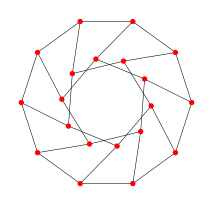
It is also a unit-distance graph (Gerbracht 2008), as shown above in a unit-distance embedding.
Finding a Hamiltonian cycle on this graph is known as the icosian game. The dodecahedral graph
is not Hamilton-connected and is the
only known example of a vertex-transitive Hamiltonian graph (other than cycle
graphs  )
that is not H*-connected
(S. Wagon, pers. comm., May 20, 2013).
)
that is not H*-connected
(S. Wagon, pers. comm., May 20, 2013).
The dodecahedral graph has 20 nodes, 30 edges, vertex connectivity 3, edge
connectivity 3, graph diameter 5, graph
radius 5, and girth 5. It has chromatic
number 3. Its graph spectrum is  (Buekenhout and
Parker 1998; Cvetkovic et al. 1998, p. 308). Its automorphism
group is of group order
(Buekenhout and
Parker 1998; Cvetkovic et al. 1998, p. 308). Its automorphism
group is of group order  (Buekenhout and Parker 1998).
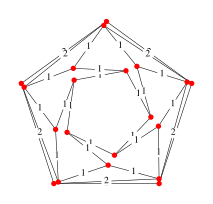
The minimal planar integral drawing of the dodecahedral graph has maximum edge length of 2 (Harborth et
al. 1987). It is also graceful (Gardner 1983,
pp. 158 and 163-164; Gallian 2018, p. 35; Knuth 2025) with 784,298,856
fundamentally different graceful labelings,
giving a total number of  graceful
labelings (B. Dobbelaere, pers. comm., Oct. 22, 2020), a number independently
(and nearly simultaneously!) determined by T. Rokicki on Oct. 6, 2020 (D. Knuth,
pers. comm., Jul. 6, 2023).
graceful
labelings (B. Dobbelaere, pers. comm., Oct. 22, 2020), a number independently
(and nearly simultaneously!) determined by T. Rokicki on Oct. 6, 2020 (D. Knuth,
pers. comm., Jul. 6, 2023).
The dodecahedral graph can be constructed as the graph expansion of  with steps 1 and 2, where
  is a path graph (Biggs 1993,
p. 119).
is a path graph (Biggs 1993,
p. 119).
The skeleton of the great stellated dodecahedron is isomorphic to the dodecahedral graph.
The line graph of the dodecahedral graph is the icosidodecahedral graph. The graph square of the dodecahedral graph is its crossed graph.
The dodecahedral graph has chromatic polynomial
 |
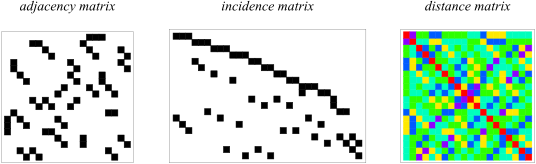
The plots above show the adjacency matrices, incidence matrices, and graph distance matrices for the dodecahedral graph.
The bipartite double graph of the dodecahedral graph is the cubic symmetric graph  .
.
The following table summarizes properties of the dodecahedral graph.



![[-10,-4,7,-7,4,-10,7,4,-4,-7]^2](/images/equations/DodecahedralGraph/Inline19.svg)



 ."
Disc. Math. 186, 69-94, 1998.Chartrand, G.
."
Disc. Math. 186, 69-94, 1998.Chartrand, G.