TOPICS
Search

Partial Bell Polynomial


A partial Bell polynomial B_(n,k)(x_1,...,x_(n-k+1)) is a polynomial that enumerates set partitions of an n-element set into exactly k nonempty blocks, with a set block of size j assigned weight x_j. The exponential convention used here is characterized by the exponential generating function

 1/(k!)(sum_(j=1)^inftyx_j(t^j)/(j!))^k=sum_(n=k)^inftyB_(n,k)(x_1,...,x_(n-k+1))(t^n)/(n!),
(1)

where k is a nonnegative integer. The boundary values are B_(0,0)=1, B_(n,0)=0 for n>0, and B_(n,k)=0 for k>n.

Equivalently, for a positive integer n,

 B_(n,k)=n!sum_(m_1+...+m_n=k; m_1+2m_2+...+nm_n=n)product_(j=1)^n1/(m_j!)((x_j)/(j!))^(m_j),
(2)

where the sum runs over nonnegative integers m_1, ..., m_n. When 1<=k<=n, the largest argument that can occur is x_(n-k+1). Each monomial has total degree k. Replacing every x_j by u^jx_j multiplies each monomial by u^n. For example,

B_(4,1)(x_1,x_2,x_3,x_4)=x_4
(3)
B_(4,2)(x_1,x_2,x_3)=4x_1x_3+3x_2^2
(4)
B_(4,3)(x_1,x_2)=6x_1^2x_2
(5)
B_(4,4)(x_1)=x_1^4.
(6)

Suppressing the arguments, a recurrence relation is
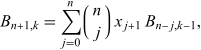
 B_(n+1,k)=sum_(j=0)^n(n; j)x_(j+1)B_(n-j,k-1),
(7)

where n is a nonnegative integer and k a positive integer. Summing the partial Bell polynomials over k gives the complete Bell polynomials.

Several counting sequences are special values,

B_(n,k)(1,...,1)=S(n,k)
(8)
B_(n,k)(1!,2!,...)=(n-1; k-1)(n!)/(k!)
(9)
B_(n,k)(1,2,3,...)=(n; k)k^(n-k),
(10)

where S(n,k) is a Stirling number of the second kind, the second row gives the Lah number, and the third gives the idempotent number, with 1<=k<=n in the last two rows (Di Nardo and Guarino 2022).

Partial Bell polynomials express the derivatives of a function composition through Faà di Bruno's formula,

 (d^n)/(dz^n)f(g(z))=sum_(k=1)^nf^((k))(g(z))B_(n,k)(g^'(z),...,g^((n-k+1))(z)),
(11)

where n is a positive integer and the necessary derivatives exist. For a random variable whose moment-generating function is defined near 0, they also express cumulants in terms of raw moments,

 kappa_n=sum_(k=1)^n(-1)^(k-1)(k-1)!B_(n,k)(mu_1^',...,mu_(n-k+1)^'),
(12)

where n is a positive integer, mu_j^' are the raw moments, and kappa_n the nth cumulant. This follows by applying Faà di Bruno's formula to the logarithm of the moment-generating function near 0.

The ordinary normalization omits the factorial divisors in the generating series,

 (sum_(j=1)^inftyx_jt^j)^k=sum_(n=k)^inftyB^^_(n,k)(x_1,...,x_(n-k+1))t^n.
(13)

It is related to the exponential normalization by

 B^^_(n,k)(x_1,...,x_(n-k+1))=(k!)/(n!)B_(n,k)(1!x_1,2!x_2,...,(n-k+1)!x_(n-k+1))
(14)

(Di Nardo and Guarino 2022). For example, B^^_(4,2)(x_1,x_2,x_3)=2x_1x_3+x_2^2, whereas B_(4,2)(x_1,x_2,x_3)=4x_1x_3+3x_2^2. The name de Moivre polynomial is used for the ordinary normalization by O'Sullivan (2022). The exponential partial Bell polynomials are implemented in the Wolfram Language as BellY[n, k, {x1, x2, ...}].



See also

Bell Polynomial, Complete Bell Polynomial, Cumulant, de Moivre Polynomial, Faà di Bruno's Formula, Idempotent Number, Lah Number, Raw Moment, Set Partition, Stirling Number of the Second Kind

Explore with Wolfram|Alpha

References

Comtet, L. Advanced Combinatorics: The Art of Finite and Infinite Expansions, rev. enl. ed. Dordrecht, Netherlands: Reidel, p. 133, 1974.Cvijović, D. "New Identities for the Partial Bell Polynomials." Appl. Math. Lett. 24, 1544-1547, 2011. https://doi.org/10.1016/j.aml.2011.03.043.Di Nardo, E. and Guarino, G. "kStatistics: Unbiased Estimates of Joint Cumulant Products from the Multivariate Faà di Bruno's Formula." R Journal 14, 208-228, 2022. https://doi.org/10.32614/RJ-2022-033.O'Sullivan, C. "De Moivre and Bell Polynomials." Expo. Math. 40, 870-893, 2022. https://doi.org/10.1016/j.exmath.2022.07.006.Roman, S. "The Bell Polynomials." §4.1.8 in The Umbral Calculus. New York: Academic Press, pp. 82-87, 1984.Wheeler, F. S. "Bell Polynomials." ACM SIGSAM Bull. 21, 44-53, 1987. https://doi.org/10.1145/29309.29317.

Cite this as:

Weisstein, Eric W. "Partial Bell Polynomial." From MathWorld--A Wolfram Resource. https://mathworld.wolfram.com/PartialBellPolynomial.html

Subject classifications




