TOPICS
Search

Lah Number


The unsigned Lah number L(n,k) counts partitions of an n-element set into k nonempty blocks with a total order on each block, where the collection of blocks is unordered. For 1<=k<=n, it is given by

 L(n,k)=B_(n,k)(1!,2!,3!,...)=(n-1; k-1)(n!)/(k!),

where B_(n,k)(x_1,...,x_(n-k+1)) is a partial Bell polynomial.

The unsigned Lah numbers form a number triangle. Row n contains L(n,k) for k=1, ..., n. The first five rows are

nk=1k=2k=3k=4k=5
11
221
3661
42436121
5120240120201

(OEIS A105278).

For n>=1 and x!=0, the Lah numbers also give the derivatives
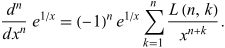
 (d^n)/(dx^n)e^(1/x)=(-1)^ne^(1/x)sum_(k=1)^n(L(n,k))/(x^(n+k)).

(Daboul et al. 2013).


See also

Bell Polynomial, Idempotent Number, Partial Bell Polynomial

Explore with Wolfram|Alpha

References

Comtet, L. Advanced Combinatorics: The Art of Finite and Infinite Expansions, rev. enl. ed. Dordrecht, Netherlands: Reidel, p. 156, 1974.Daboul, S.; Mangaldan, J.; Spivey, M. Z.; and Taylor, P. J. "The Lah Numbers and the nth Derivative of e^(1/x)." Math. Mag. 86, 39-47, 2013. https://doi.org/10.4169/math.mag.86.1.039.Roman, S. The Umbral Calculus. New York: Academic Press, p. 86, 1984.Rota, G.-C.; Kahaner, D.; Odlyzko, A. "On the Foundations of Combinatorial Theory. VIII: Finite Operator Calculus." J. Math. Anal. Appl. 42, 684-760, 1973.Sloane, N. J. A. Sequence A105278 in "The On-Line Encyclopedia of Integer Sequences."

Referenced on Wolfram|Alpha

Lah Number

Cite this as:

Weisstein, Eric W. "Lah Number." From MathWorld--A Wolfram Resource. https://mathworld.wolfram.com/LahNumber.html

Subject classifications

