


The number of ways of partitioning a set of  elements into
  nonempty sets (i.e.,
  set blocks), also called a Stirling
set number. For example, the set
set blocks), also called a Stirling
set number. For example, the set  can be partitioned into three subsets
in one way:
can be partitioned into three subsets
in one way:  ; into two subsets in
three ways:
; into two subsets in
three ways:  ,
,  , and
, and  ; and into one subset
in one way:
; and into one subset
in one way:  .
.
Equivalently,  counts the ways of distributing
  distinct balls into
  identical nonempty boxes, one of the cases in the twelvefold
way.
identical nonempty boxes, one of the cases in the twelvefold
way.
The Stirling numbers of the second kind are variously denoted  (Riordan 1980, Roman 1984),
  (Fort 1948; Abramowitz and Stegun 1972, p. 822),
 (Jordan 1965),
  ,
,  , or Knuth's notation
  (Graham et al. 1994; Knuth 1997, p. 65).
Abramowitz and Stegun (1972, p. 822) summarize the various notational conventions,
which can be a bit confusing. The Stirling numbers of the second kind are implemented
in the Wolfram Language as StirlingS2[n,
m], and denoted
(Graham et al. 1994; Knuth 1997, p. 65).
Abramowitz and Stegun (1972, p. 822) summarize the various notational conventions,
which can be a bit confusing. The Stirling numbers of the second kind are implemented
in the Wolfram Language as StirlingS2[n,
m], and denoted  .
.
The Stirling numbers of the second kind for three elements are
 |  |  |
(1)
|
 |  |  |
(2)
|
 |  |  |
(3)
|
Since a set of  elements can only be partitioned in a single way into 1 or
 subsets,
 |
(4)
|
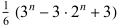
Other special cases include
 |  |  |
(5)
|
 |  |  |
(6)
|
 |  |  |
(7)
|
 |  |  |
(8)
|
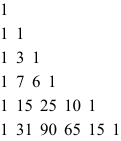
The triangle of Stirling numbers of the second kind is
 |
(9)
|
(OEIS A008277), the  th row of which corresponds to the coefficients of the Bell
polynomial
th row of which corresponds to the coefficients of the Bell
polynomial  .
.
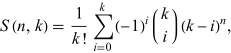
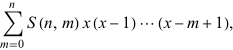
The Stirling numbers of the second kind can be computed from the sum
 |
(10)
|
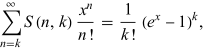
with 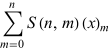 a binomial coefficient, or the generating
functions
a binomial coefficient, or the generating
functions
 |  |  |
(11)
|
 |  |  |
(12)
|
where  is the falling factorial (Roman 1984, pp. 60
and 101),
is the falling factorial (Roman 1984, pp. 60
and 101),
 |
(13)
|
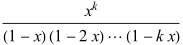
and
 |  |  |
(14)
|
 |  |  |
(15)
|
 |  |  |
(16)
|
for  (Abramowitz and Stegun 1972, p. 824; Stanley 1997, p. 57), where
  is a Pochhammer symbol.
Another generating function is given by
is a Pochhammer symbol.
Another generating function is given by
 |
(17)
|
for  ,
where
,
where  is the polylogarithm.
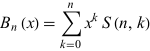
Stirling numbers of the second kind are intimately connected with the Poisson distribution through Dobiński's formula
 |
(18)
|
where  is a Bell polynomial.
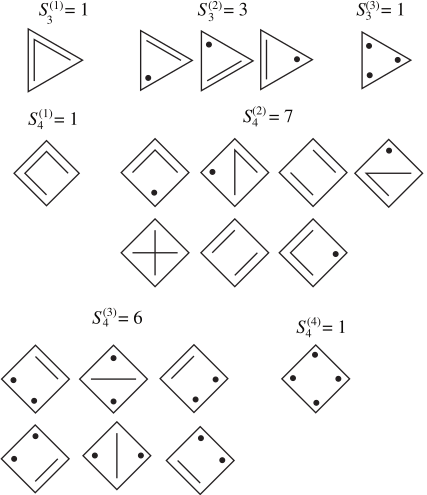
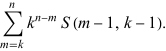
The above diagrams (Dickau) illustrate the definition of the Stirling numbers of the second kind  for
for  and 4. Stirling numbers of the second kind obey the recurrence
relations
and 4. Stirling numbers of the second kind obey the recurrence
relations
 |  |  |
(19)
|
 |  |  |
(20)
|
The Stirling numbers of the first kind  are connected with the Stirling numbers of the second kind
  . For example, the matrices
  and
and  are inverses of
each other, where
are inverses of
each other, where  denotes the matrix with
  th entry
  for
for  , ...,
  (G. Helms, pers. comm., Apr. 28, 2006).
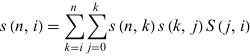
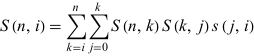
Other formulas include
 |
(21)
|
 |
(22)
|
(Roman 1984, p. 67), as well as
 |
(23)
|
 |
(24)
|
 |
(25)
|
 |
(26)
|
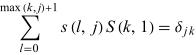
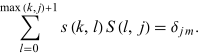
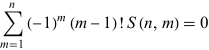
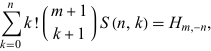
Identities involving Stirling numbers of the second kind are given by
 |
(27)
|
 |
(28)
|
where 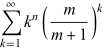 is a generalized harmonic number, and
 |  | 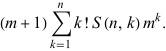 |
(29)
|
 |  |  |
(30)
|
The sequence  is given by 2, 6, 26, 150, 1082, 9366, 94586, 1091670,
... (OEIS A000629; Konhauser et al. 1996,
p. 174), and can have only 0, 2, or 6 as a last digit
(Riskin 1995). An additional curious identity due to K. A. Penson (pers.
comm., April 10, 2002) is given by
is given by 2, 6, 26, 150, 1082, 9366, 94586, 1091670,
... (OEIS A000629; Konhauser et al. 1996,
p. 174), and can have only 0, 2, or 6 as a last digit
(Riskin 1995). An additional curious identity due to K. A. Penson (pers.
comm., April 10, 2002) is given by
![sum_(k=0)^inftyk^n[k+1-(Gamma(k+2,1))/(Gamma(k+1))]=sum_(k=0)^n(S(n,k))/(k+2)](/images/equations/StirlingNumberoftheSecondKind/NumberedEquation15.svg) |
(31)
|
for  ,
1, ..., where
,
1, ..., where  is an incomplete
gamma function,
is an incomplete
gamma function,  is a gamma function,
and
is a gamma function,
and  is taken to be 1 for
  .
.
Stirling numbers of the second kind also occur in identities involving the differential operator  .
.

 ." Proc. Amer. Math. Soc. 11, 452-455,
1960.Comtet, L.
." Proc. Amer. Math. Soc. 11, 452-455,
1960.Comtet, L.